















Introduction
The concept of USB-C cable wattage explained (60W 100W 240W) is essential for understanding modern fast charging performance across smartphones, tablets, and laptops.
USB-C cables do not all deliver the same power. Their wattage rating defines how much electrical energy they can safely transfer under USB Power Delivery (USB-PD) standards.
For OEM buyers, wholesalers, and US/EU e-commerce sellers, selecting the correct wattage level is critical for product positioning, safety compliance, and customer satisfaction.
OSKO analyzes USB-C wattage not as a marketing label, but as an electrical engineering specification tied directly to conductor design, chip architecture, and thermal safety systems.

Material Science & Electrical Engineering Principles
What Does USB-C Wattage Mean?
Wattage (W) is calculated as:
Power (W) = Voltage (V) × Current (A)
USB-C cables support different power levels depending on internal structure and certification:
60W → Entry-level fast charging
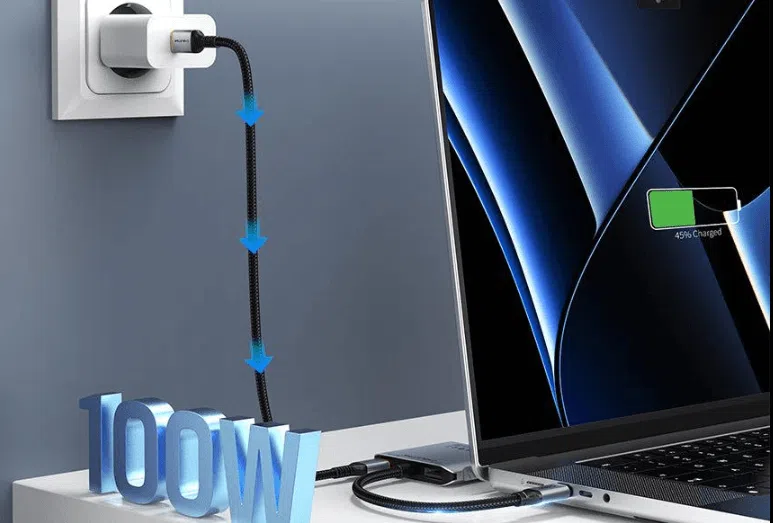
100W → High-performance laptop charging
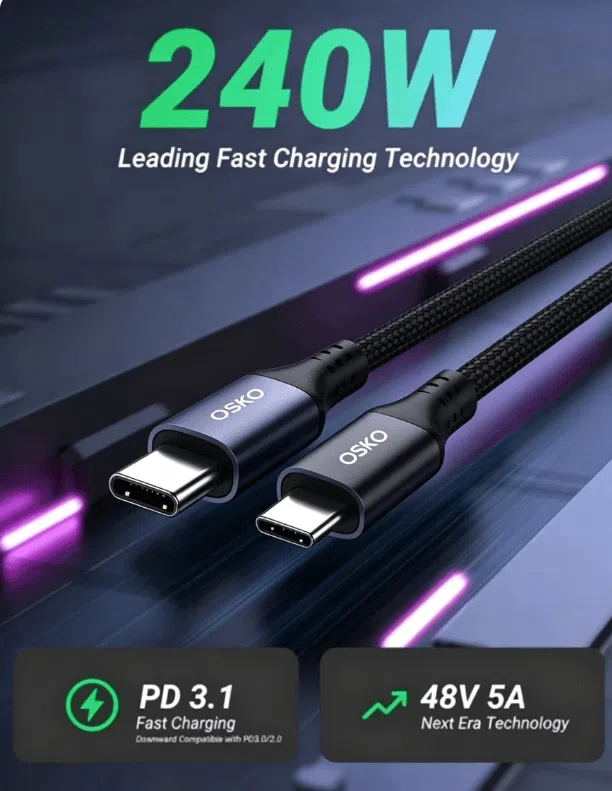
240W → Next-generation PD 3.1 extended power
Each level requires different engineering design.
60W USB-C Cable Explained
A 60W USB-C cable is commonly used for:
Smartphones
Tablets
Lightweight laptops
Technical characteristics:
Typically supports up to 20V / 3A
Uses 24AWG–22AWG conductors
Often does not require advanced E-Marker chips (depending on design)
Optimized for stable mobile charging
This is the most common category in consumer markets.
100W USB-C Cable Explained
A 100W USB-C cable is designed for higher power devices:
Professional laptops
Docking stations
High-performance tablets
Technical requirements:
Supports up to 20V / 5A
Requires E-Marker chip for safe negotiation
Uses thicker copper conductors (22AWG or lower)
Enhanced shielding for EMI protection
This is a standard level in premium USB-C fast charging cable OEM systems.
240W USB-C Cable (PD 3.1) Explained
The 240W USB-C cable is based on USB Power Delivery 3.1 (Extended Power Range):
Supports up to 48V / 5A
Designed for gaming laptops and workstations
Requires advanced thermal and electrical design
Key engineering requirements:
Mandatory E-Marker chip
Ultra-low resistance copper conductors
Multi-layer shielding system
High-grade insulation materials (TPE / nylon braided)
This represents the top-tier of modern USB-C charging technology.
E-Marker Chip Role in Wattage Control
E-Marker chips are critical for 100W and 240W cables.
They:
Identify cable power rating
Prevent overcurrent damage
Enable safe USB-PD negotiation
Ensure compatibility with high-power devices
Without E-Marker, high-wattage cables cannot function safely.
Thermal Management Differences
Higher wattage means higher heat generation:
60W → Low heat load
100W → Moderate heat control required
240W → Advanced thermal engineering required
Cable design must include:
Low resistance copper
Heat-resistant insulation
Efficient energy transfer pathways
Case Study
US Laptop Accessory Brand Power Segmentation Project
Customer Background
A US e-commerce brand selling USB-C charging cables experienced customer confusion between 60W and 100W products, leading to compatibility complaints and return requests.
The goal was to clearly define wattage segmentation in their USB-C cable product line.
Engineering Problems Identified
Key issues included:
Mislabeling of wattage capability
Lack of E-Marker integration in higher wattage models
Inconsistent conductor thickness across products
Poor differentiation in Amazon listings
Customer misunderstanding of device compatibility
OSKO Engineering Solution
OSKO implemented a structured wattage classification system:
60W cables optimized for mobile devices
100W cables designed for laptops with E-Marker chips
240W cables engineered for PD 3.1 systems
Standardized AWG wire mapping for each category
Improved shielding for high-power stability
Manufacturing aligned with:
USB-IF compliant Type C cable manufacturer standards
ISO9001 quality control system
FCC EMI compliance testing
RoHS material safety validation
Result
Product confusion significantly reduced
Return rates decreased
Customer satisfaction improved
Amazon listing clarity increased conversion rates
Brand positioning became more structured
Selection Guide
USB-C Wattage Comparison (60W vs 100W vs 240W)
1. Device Compatibility
60W → Phones, tablets, entry laptops
100W → Professional laptops, MacBook Pro
240W → Gaming laptops, workstation systems
2. Electrical Design Requirements
60W → Standard copper conductors
100W → Reinforced conductors + E-Marker
240W → Ultra-low resistance + advanced shielding
3. Cable Construction
60W → Lightweight structure
100W → Reinforced durability
240W → Industrial-grade engineering design
4. Data Support Levels
60W → USB 2.0 typical
100W → USB 2.0 / USB 3.2 optional
240W → USB 3.2 / USB4 compatibility
Comparison Table
| Wattage | Voltage/Current | Device Type | E-Marker | Use Case |
|---|---|---|---|---|
| 60W | 20V / 3A | Phones/Tablets | Optional | Daily charging |
| 100W | 20V / 5A | Laptops | Required | Professional use |
| 240W | 48V / 5A | Workstations | Mandatory | High-performance systems |
Application Scenarios
USB-C wattage-based cables are widely used in:
OEM USB cables for branded electronics
ODM USB cables for custom engineering projects
USB cables for wholesale distribution networks
Desktop charging cables for office workstation setups
Travel USB cables for portable charging kits
In-car charging cables for automotive systems
Home USB cables for multi-device ecosystems
FAQ
Can a 100W cable charge a 60W device?
Yes, devices only draw the power they need.
Is 240W USB-C safe for phones?
Yes, charging is automatically regulated by the device.
Do all cables support 100W charging?
No, only cables with proper design and E-Marker support do.
Why is 240W cable more expensive?
Due to higher-grade copper, chips, and thermal engineering.
Do I need 240W cable for everyday use?
Not necessarily—60W or 100W is sufficient for most users.
Summary
The concept of USB-C cable wattage explained (60W 100W 240W) is fundamentally based on electrical engineering, not just marketing labels.
Each wattage level represents a different design standard involving conductor thickness, E-Marker chip integration, thermal control, and USB-PD compatibility.
OSKO engineers cable systems based on real device requirements to ensure safe, stable, and efficient charging performance across US and European markets.
Wattage is not just power—it defines the entire engineering architecture of a USB-C cable.
Contact Information
OSKO provides OEM/ODM USB-C cable solutions including:
60W / 100W / 240W fast charging cables
Braided and high-flex cable systems
Private label customization for Amazon and retail
Full USB-IF and FCC compliance support
Engineering-grade testing and validation
OSKO engineering team delivers scalable USB-C power solutions for global markets.
