















Introduction
For iPhone users and accessory brands, choosing a reliable MFi certified USB-C to Lightning cable is one of the most important decisions when developing or purchasing Apple-compatible charging products.
Many buyers assume that any USB-C to Lightning cable can safely charge an iPhone. However, Apple Lightning products require precise connector design, compatibility control, and authentication technology to ensure stable communication between the cable and the device.
A certified cable provides confidence in:
iPhone compatibility
Charging stability
Data transmission reliability
Product safety
For retailers and distributors in the US market, MFi certification is also an important factor in reducing product returns and building customer trust.
A professional USB-C to Lightning cable manufacturer must combine certification requirements with engineering capabilities, including conductor design, insulation materials, connector structure, and quality testing.
Material Science & Electrical Performance
What Is an MFi Certified USB-C to Lightning Cable?
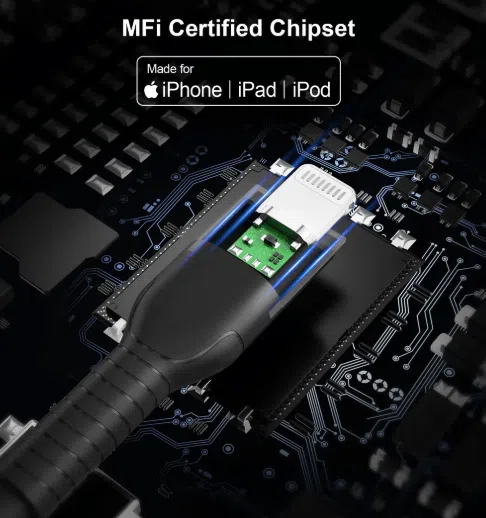
MFi means Made for iPhone/iPad/iPod, an Apple licensing program designed for accessory manufacturers that meet Apple’s technical requirements.
An MFi certified Lightning cable typically includes:
Approved Lightning connector components
Apple authentication technology
Compliance with technical specifications
Quality manufacturing controls
The certification helps ensure that the cable communicates correctly with Apple devices.
Why MFi Certification Matters for iPhone Charging
A Lightning cable is not only responsible for transferring electricity.
It also manages:
Device recognition
Charging communication
Data transfer
Power negotiation
Without proper compatibility, users may experience:
Slow charging
Connection interruptions
Accessory warnings
Unstable performance
For commercial products, these issues can lead to:
Higher return rates
Negative reviews
Customer complaints
USB-C PD Fast Charging Performance
A major advantage of USB-C to Lightning cables is compatibility with USB Power Delivery charging.
Charging system:
USB-C PD Charger → USB-C Connector → Cable → Lightning Connector → iPhone
A properly designed cable supports:
Stable current transmission
Efficient power delivery
Reduced energy loss
Common applications include:
| Application | Charging Environment |
|---|---|
| Home charging | USB-C wall adapter |
| Office charging | Laptop USB-C charger |
| Travel charging | Portable PD charger |
| Vehicle charging | USB-C car charger |
Cable Structure and Material Engineering
Conductor Design
The internal conductor directly affects charging performance.
High-quality MFi certified cables typically use:
High-purity copper conductors
Multi-strand wire structures
Optimized resistance control
Benefits:
Stable charging current
Lower heat generation
Longer service life
Insulation Material Selectioz
The insulation layer protects the internal wires and maintains signal stability.
Common materials:
| Material | Characteristics |
|---|---|
| PVC | Cost-effective, standard applications |
| TPE | Flexible and durable |
| HDPE | Good dielectric performance and signal stability |
For premium charging cables, manufacturers often optimize insulation thickness and material selection to balance flexibility and electrical performance.
Nylon Braided Outer Protection
A premium braided USB-C to Lightning cable often uses nylon fiber protection.
Advantages:
Higher abrasion resistance
Better bending durability
Improved appearance
Longer product lifespan
Typical applications:
Premium retail products
Travel charging kits
Professional users
Corporate accessories
Case Study
US Electronics Brand Developed MFi Certified Lightning Cable Product Line
A US consumer electronics company wanted to launch a premium iPhone charging accessory series.
The company previously sold generic charging cables but faced several market challenges.
Customer Requirements
The brand required:
Reliable Apple compatibility
MFi certification support
Premium braided appearance
Fast charging capability
Custom retail packaging
Engineering Challenges
OSKO analyzed the previous product samples and identified:
Compatibility Issues
Unstable device recognition
Inconsistent charging performance
Mechanical Issues
Connector damage after repeated use
Weak cable bending protection
Manufacturing Issues
Limited customization capability
Lack of consistent quality control
OSKO Engineering Solution
OSKO developed a customized cable solution:
Electrical Design
Optimized conductor structure
Stable USB-PD charging performance
Improved power transmission efficiency
Mechanical Design
Nylon braided jacket
Reinforced Lightning connector
Improved strain relief system
Production Management
Certification support
Batch inspection
Custom packaging development
The project supported:
OEM Apple charging cable production
ODM Lightning cable solutions
Retail iPhone accessory products
Wholesale charging cable supply
Project Results
After implementation:
Product reliability improved
Customer complaints decreased
Retail positioning upgraded
Brand trust increased

Selection Guide
How to Choose an MFi Certified USB-C to Lightning Cable
Verify Certification Information
When sourcing products, buyers should confirm:
Manufacturer authorization
Certification status
Connector authenticity
Testing documentation
Certification helps ensure compatibility but should be combined with quality manufacturing.
Evaluate Cable Construction
A professional cable should include:
| Component | Recommended Feature |
|---|---|
| Conductor | High-quality copper |
| Insulation | Stable dielectric material |
| Jacket | Nylon braid or durable TPU |
| Connector | Reinforced Lightning design |
| Testing | Charging and durability tests |
Choose the Right Cable Length
Different markets require different lengths:
| Length | Application |
|---|---|
| 3ft | Travel and power banks |
| 6ft | Home and office charging |
| 10ft | Flexible indoor charging |
OEM buyers often develop multiple lengths to cover different customer needs.
OEM Procurement Guide for MFi Lightning Cables
For brands sourcing Apple charging products, supplier capability is critical.
A reliable manufacturer should support:
MFi certified Lightning cable production
OEM USB cable development
ODM charging cable customization
Bulk wholesale production
Custom packaging solutions
Professional manufacturing capabilities include:
USB-IF compliant Type C cable manufacturer
ISO9001 certified braided USB cable factory
Custom packaging braided charging cable factory
OEM ODM custom length USB C cables
Bulk custom color braided charging cables
MFi Certified Cable vs Non-Certified Cable Comparison
| Feature | MFi Certified Cable | Non-Certified Cable |
|---|---|---|
| Apple Compatibility | High | Uncertain |
| Charging Stability | Reliable | Variable |
| Quality Control | Controlled | Depends on supplier |
| Retail Value | Premium | Low-cost |
| Long-Term Reliability | Better | Higher risk |
FAQ
What does MFi certified mean for a Lightning cable?
MFi certification means the cable meets Apple’s accessory requirements for compatibility and performance.
Are all USB-C to Lightning cables MFi certified?
No. Some third-party cables are not certified and may have inconsistent compatibility.
Can an MFi cable fast charge an iPhone?
Yes. When paired with a compatible USB-C PD charger, an MFi certified cable can support fast charging for compatible iPhones.
Is MFi certification enough to guarantee cable quality?
Certification ensures compatibility, but overall quality also depends on materials, engineering, and manufacturing control.
Why should retailers choose MFi certified cables?
MFi products typically provide better customer confidence, fewer compatibility issues, and stronger retail positioning.
Summary
A MFi certified USB-C to Lightning cable provides a reliable solution for Apple users who require stable charging, compatibility, and long-term performance.
The key factors include:
Apple-approved compatibility
USB-PD charging support
Quality conductor materials
Reinforced connector design
Professional manufacturing standards
For consumers, MFi certification helps reduce charging risks.
For brands and distributors targeting the US market, selecting an experienced OEM partner like OSKO enables the development of reliable Lightning cable products with customization, quality control, and scalable production.
Contact Information
OSKO provides professional OEM and ODM Apple charging cable solutions:
MFi certified USB-C to Lightning cable development
Braided iPhone charging cables
Custom length and color options
Private label packaging
Wholesale production
OSKO engineering team supports global brands with cable structure design, material optimization, testing support, and professional manufacturing services.
