
Introduction
When bringing data cables to the U.S. market, certification is not just a regulatory formality—it is a critical requirement that determines whether a product can legally enter retail channels, be listed on Amazon, or be accepted by distributors and importers.
The U.S. market places strong emphasis on electrical safety, electromagnetic compatibility, and material compliance. For USB-C cables, Lightning cables, and fast charging cables, certifications directly affect product approval, customer trust, and long-term scalability.
Understanding what certifications should be considered when bringing data cables to the U.S. market is essential for OEM buyers, importers, and brand owners who want stable supply chains and low compliance risk.

Material Science & Regulatory Compliance Framewor
Certifications are built upon engineering validation of materials and electrical performance.
FCC Certification (Electromagnetic Compatibility Standard)
FCC compliance is one of the most important requirements for U.S. electronic accessories.
It ensures:
No harmful electromagnetic interference (EMI)
Stable signal transmission in real environments
Safe operation alongside other electronic devices
For data cables and USB-C charging cables, FCC compliance is often required for retail and Amazon listings.
USB-IF Certification (USB Protocol Standard)
USB-IF certification ensures correct implementation of USB standards:
USB Power Delivery (USB-PD) compatibility
Correct voltage and current negotiation
Device interoperability across ecosystems
Cables without USB-IF validation may:
Fail fast charging negotiation
Cause unstable data transfer
Trigger device compatibility issues
This is especially important for high-speed USB-C data cable systems.
RoHS Compliance (Hazardous Substance Restriction)
RoHS ensures that cables do not contain restricted materials such as:
Lead (Pb)
Mercury (Hg)
Cadmium (Cd)
Certain flame retardants
RoHS is essential for:
US retail import safety expectations
Global supply chain compatibility
Environmental compliance requirements
REACH Compliance (Chemical Safety Standard)
REACH focuses on chemical safety in materials used during manufacturing.
It ensures:
Safe plasticizers and insulation materials
Transparent chemical composition disclosure
Reduced environmental and health risks
REACH is particularly important for European export but increasingly expected in global supply chains.
Prop 65 (California Market Requirement)
For products sold in California or through Amazon US:
Warning labels may be required for certain chemical exposure risks
Applies to cable insulation materials and connectors
Ensures consumer awareness of chemical content
Many importers overlook this requirement, leading to listing risks.
Case Study
US Amazon Cable Brand Compliance Upgrade Project
Customer Background
A US-based Amazon seller importing USB-C data cables faced repeated listing removals due to inconsistent compliance documentation and unclear certification status from multiple suppliers.
The goal was to build a fully compliant data cable supply chain for the U.S. market.
Engineering Problems Identified
Key issues included:
Missing FCC test reports for cable batches
Non-standard USB-PD performance behavior
Lack of RoHS and material traceability documentation
No unified certification framework across suppliers
Amazon compliance rejection due to incomplete documentation
OSKO Engineering Solution
OSKO implemented a structured compliance system:
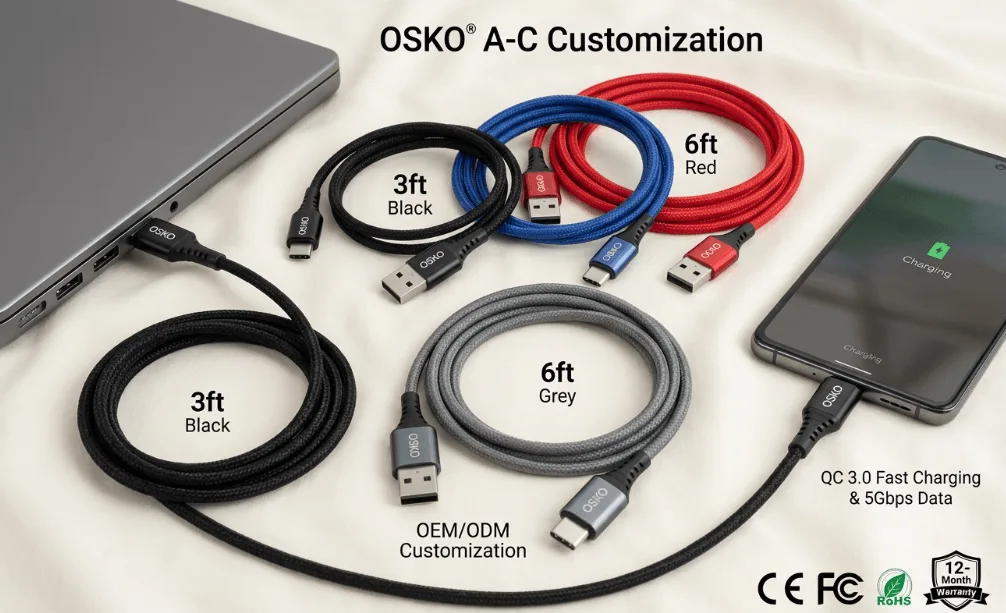
Full USB-IF compliant Type C cable manufacturer validation framework
FCC electromagnetic interference testing for all production batches
RoHS and REACH material screening system
Prop 65 compliance labeling for California distribution
ISO9001 production quality control and traceability system
Each shipment included:
Certification documentation package
Electrical performance test reports
Batch traceability records
Material compliance declarations
Result
After implementation:
Amazon approval rate reached 100%
Listing rejections eliminated
Supply chain transparency significantly improved
Customer trust and brand rating increased
Distribution expanded into US retail channels
This demonstrates that certification directly determines market access success.
Selection Guide
Key Certifications for U.S. Data Cable Market Entry
1. FCC Certification
Mandatory for electromagnetic compatibility:
Prevents signal interference
Ensures stable operation with other devices
Required for most electronic accessories in the U.S.
2. USB-IF Certification
Defines USB protocol compliance:
Ensures USB-C functionality correctness
Validates USB-PD charging behavior
Guarantees cross-device compatibility
3. RoHS Compliance
Restricts hazardous materials:
Ensures environmental safety
Required for most global retail channels
Important for import clearance
4. REACH Compliance
Chemical safety framework:
Controls material composition
Ensures safe plastic and insulation usage
Increasingly required in global sourcing
5. Prop 65 Compliance
California-specific requirement:
Requires chemical warning labeling
Important for Amazon US sellers
Prevents regulatory penalties in California market
Certification Comparison Table
| Certification | Region | Focus | Importance |
|---|---|---|---|
| FCC | USA | EMI safety | Critical |
| USB-IF | Global | USB protocol | Critical |
| RoHS | Global | Material safety | High |
| REACH | EU/global | Chemical safety | High |
| Prop 65 | California | Consumer warning | Market-specific |
| ISO9001 | Global | Quality system | Structural |
Application Scenarios
Certified data cables are widely used in:
OEM USB cables for branded electronics manufacturing
ODM USB cables for customized product development
USB cables for wholesale distribution networks
Desktop charging cables for office workstation setups
Travel USB cables for portable charging kits
In-car charging cables for automotive environments
Home USB cables for multi-device ecosystems
FAQ
Do all USB cables need FCC certification?
Most electronic USB cables sold in the U.S. require FCC compliance for EMI safety.
Is USB-IF certification mandatory?
Not legally required, but highly recommended for performance and compatibility assurance.
What happens if a cable is not RoHS compliant?
It may face import restrictions or retail platform rejection.
Is Prop 65 required for all U.S. states?
No, it applies mainly to California but often affects nationwide e-commerce listings.
Why are certifications important for OEM buyers?
They ensure legal compliance, product safety, and stable market access.
Summary
When bringing data cables to the U.S. market, certifications such as FCC, USB-IF, RoHS, REACH, Prop 65, and ISO9001 form the foundation of compliance, safety, and commercial success.
These certifications validate electrical performance, material safety, and manufacturing quality, ensuring products meet the strict expectations of US retail and e-commerce channels.
OSKO integrates full certification control and engineering validation into its OEM/ODM manufacturing system to ensure every cable is ready for U.S. market entry.
In modern supply chains, certification is not optional—it is a core part of product engineering and brand credibility.
Contact Information
OSKO provides OEM/ODM data cable solutions including:
FCC/USB-IF certified USB-C cables
RoHS & REACH compliant production systems
Amazon-ready retail packaging
Private label manufacturing support
Full compliance documentation services