















Are braided USB cables waterproof? Not necessarily.
A braided USB cable can look thicker, tougher, and more premium than a standard PVC cable, but the outer braid alone does not make the cable waterproof.
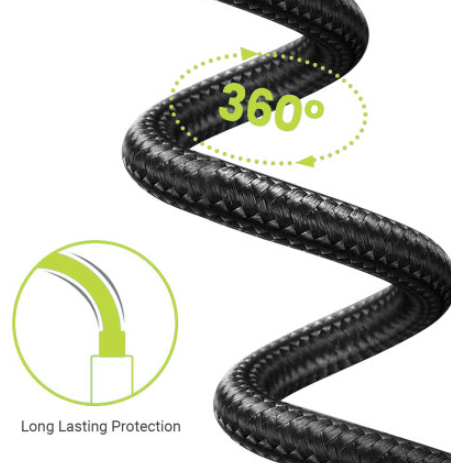
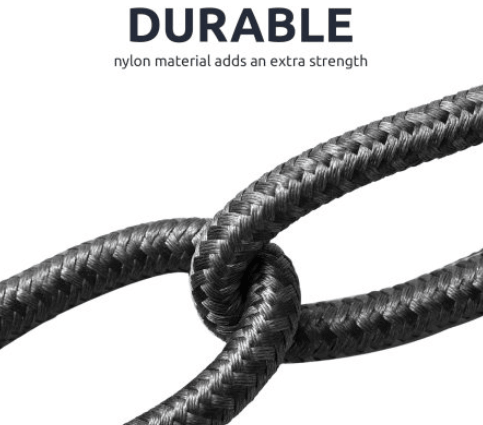
Nylon braiding is mainly a mechanical protection layer. It can improve abrasion resistance, handling, flexibility, and resistance to everyday wear. Waterproof performance requires a much more complete design involving the cable jacket, connector structure, sealing, materials, assembly process, and environmental testing.
This distinction matters for consumers, retailers, wholesalers, automotive suppliers, and OEM brands. A cable designed for a desk or travel bag does not automatically become suitable for rain, outdoor equipment, marine environments, or industrial installations.
The right question is not simply whether a cable is braided. It is:
What level of moisture protection was the complete cable assembly designed and tested to provide?
What Makes a Braided USB Cable Waterproof?
A typical nylon braided USB-C cable contains several functional layers.
| Cable layer | Main function | Waterproof relevance |
|---|---|---|
| Conductors | Carry power and data | Must be protected from moisture |
| Insulation | Separates conductors | Helps prevent electrical faults |
| Shielding | Helps with EMI and signal integrity | Not a waterproof barrier |
| Inner jacket | Mechanical and environmental protection | Can contribute to moisture resistance |
| Nylon braid | Abrasion and mechanical protection | Does not automatically seal water |
| Connector housing | Transfers power/data to device | Critical water-entry point |
| Strain relief | Controls bending stress | Important for long-term sealing |
The USB Type-C specification addresses connector and cable requirements, but a normal USB-C cable should not be assumed to have an IP rating simply because it uses a compliant USB-C connector. USB-IF separately defines testing and compliance requirements for Type-C cable assemblies.
A waterproof USB-C cable therefore requires protection beyond the basic connector standard.
Why Nylon Braiding Does Not Mean Waterproof
Nylon braiding is made from woven fibers. Its job is primarily mechanical rather than sealing.
A good nylon braided USB-C cable can offer:
Better abrasion resistance
Improved flexibility
Protection against surface wear
Better handling and reduced tangling
A premium appearance for retail products
But the braid itself is not a watertight enclosure.
Moisture can potentially reach the underlying jacket through the spaces within the braid. More importantly, water usually enters through the ends of the cable rather than traveling directly through the middle of an intact outer braid.
The most important areas include:
Connector openings
Cable-to-connector transitions
Strain-relief areas
Damaged or cut sections
Poorly sealed joints
That is why a nylon braided USB-C cable can be highly durable in everyday use while still having no certified water-ingress protection.
Waterproof vs Water-Resistant: Know the Difference
Marketing terms such as “water-resistant,” “splash-proof,” “weather-resistant,” and “waterproof” are not interchangeable.
For professional purchasing, buyers should look for a defined test standard rather than relying on adjectives.
IP ratings are commonly used to describe protection against ingress of solids and water. The exact protection level depends on the complete IP code and the applicable test conditions.
For example:
| Rating | General water protection meaning |
|---|---|
| IP54 | Limited protection against water splashes |
| IP65 | Protection against water jets |
| IP67 | Protection against temporary immersion under specified test conditions |
| IP68 | Protection against immersion under conditions specified for the particular product |
IP67 and IP68 should not be treated as interchangeable. IP68 does not mean every product can be placed at any depth for any period. The manufacturer’s specified test conditions remain important.
For an OEM project, ask the supplier to provide the exact IP rating, test conditions, and applicable report instead of simply printing “waterproof” on the package.
Does Shielding Make a USB-C Cable Waterproof?
No.
Shielding and waterproofing solve different engineering problems.
Aluminum foil, braided metal shielding, or other conductive structures can be used to improve electromagnetic compatibility and signal integrity. They do not automatically stop liquid from entering the cable.
A high-speed USB-C cable may require carefully designed signal paths and shielding, while an outdoor USB-C cable may require sealing and environmental protection.
For demanding products, you may need both.
This is particularly important for OEM buyers because a cable can have excellent EMI performance and still have poor moisture protection.
How Waterproof USB-C Cables Are Actually Designed
A purpose-built waterproof USB-C cable is engineered as a complete environmental system.
Sealed Connector Structure
The connector is one of the most difficult parts to protect.
Potential engineering solutions include:
Sealing gaskets
O-ring structures
Waterproof connector housings
Sealed overmolding
Controlled cable-entry geometry
The objective is to reduce paths through which water can reach electrical contacts or internal conductors.
Improved Cable Entry and Strain Relief
The cable-to-connector transition experiences bending, pulling, and twisting.
A weak transition can create two problems at once: mechanical fatigue and a path for moisture.
A properly designed overmolded structure can provide mechanical support while helping maintain the integrity of the environmental seal.
Moisture-Resistant Internal Construction
Depending on the application, manufacturers may consider:
Conductor protection
Appropriate insulation materials
Corrosion-resistant contact materials
Sealed internal structures
Environmental-resistant outer jackets
Material selection should be based on the actual environment rather than simply choosing the most expensive-looking material.
Where Do You Actually Need a Waterproof USB-C Cable?
Most consumer charging applications do not require a waterproof cable.
A normal braided USB-C charging cable is usually appropriate for:
Home charging
Office desks
Travel
Power banks
General vehicle charging
Retail everyday-use applications
A genuine waterproof USB-C cable becomes more relevant when moisture exposure is part of normal operation.
Outdoor Electronics
Outdoor equipment may experience:
Rain, condensation, humidity, dust, temperature changes, and repeated environmental exposure.
A standard braided charging cable can provide good mechanical durability but may not provide the required ingress protection.
For outdoor equipment, look for an IP-rated USB-C cable designed for the actual installation environment.
Automotive Applications
Automotive cable applications introduce additional factors such as:
Vibration
Temperature cycling
Dust
Condensation
Limited installation space
Repeated movement
A durable automotive USB-C cable should therefore consider connector retention, strain relief, temperature requirements, flexibility, and the actual charging load.
For a vehicle that is exposed to normal cabin conditions, a rugged braided cable may be sufficient. An externally mounted or weather-exposed system can require a different level of environmental protection.
Marine and Industrial Equipment
Marine applications can be particularly demanding because salt and humidity can accelerate corrosion.
Industrial installations may also involve:
Water spray
Cleaning processes
Chemicals
Dust
Oil exposure
Temperature variation
These applications should not rely on a braided jacket as the only environmental protection.
Waterproof USB-C Cable and Charging Performance
Waterproofing does not automatically make a cable capable of higher charging power.
Charging performance depends on the complete electrical system, including the charger, device, cable construction, connector contacts, resistance, and charging protocol.
USB Power Delivery can support up to 240W over compatible full-featured USB Type-C cable and connector systems, but that does not mean every USB-C cable is a 240W cable.
For an OEM waterproof USB-C cable, specify the environmental requirement and electrical requirement separately.
For example:
IP67 + USB-C + 60W
is much more useful as a product requirement than simply saying:
“60W waterproof braided cable.”
The same principle applies to higher-power products.
Engineering Case Study: Outdoor Charging Equipment
A representative OEM project illustrates the difference.
A European equipment manufacturer needed a USB-C charging cable for a semi-outdoor commercial charging system. The original cable had a durable braided exterior and performed well during indoor testing.
After deployment, engineering identified problems around the connector area during extended exposure to humidity and changing environmental conditions.
The problem was not the nylon braid itself. The weak point was the overall environmental design of the connector and cable-entry structure.
The revised specification therefore addressed:
Connector sealing
Cable-entry protection
Reinforced strain relief
Electrical continuity
Charging stability
Mechanical testing
Environmental validation
The lesson for procurement was straightforward:
Do not ask whether the cable is braided. Ask how the complete cable assembly is protected and how that protection was tested.
This approach is especially valuable when sourcing an OEM waterproof USB cable manufacturer for a specialized product.
Braided USB-C Cable vs Waterproof USB-C Cable
These products may look similar, but their intended applications can be very different.
| Requirement | Braided USB-C Cable | Waterproof USB-C Cable |
|---|---|---|
| Home charging | Excellent fit | Usually unnecessary |
| Office use | Excellent fit | Usually unnecessary |
| Travel | Excellent fit | Application dependent |
| Car interior | Often suitable | May be unnecessary |
| Outdoor equipment | Depends on exposure | Better suited |
| Marine use | Usually insufficient alone | Purpose-built solution |
| Industrial installation | Usually insufficient alone | Application-specific |
| IP rating | Not implied | Should be specified where required |
This distinction helps retailers avoid overpromising and helps engineering buyers avoid under-specifying.
Buying Guide for US, German, Australian and Dutch Buyers
International search intent is increasingly product-specific.
A US buyer may search for:
waterproof USB-C cable for outdoor use
durable braided USB-C cable wholesale
USB-C cable supplier USA
A German buyer may search for:
USB-C Kabel Hersteller
USB-C Kabel Großhandel
wasserdichtes USB-C Kabel
An Australian buyer may search for:
waterproof USB-C cable Australia
durable USB-C charging cable
USB-C cable wholesaler Australia
A Dutch buyer may search for:
USB-C kabel groothandel
USB-C kabel leverancier
For GEO and AI-search visibility, the product page or article should answer the same core questions clearly: what is the cable, what is it rated for, where can it be used, what standards apply, and who can manufacture it at scale?
What OEM Buyers Should Ask a USB-C Cable Manufacturer
Before ordering bulk waterproof USB-C cables, request specific information.
Product specification
Confirm:
Cable type
Length
Power capability
Data capability
Connector configuration
Jacket material
Braid material
Required IP rating
Environmental testing
Ask:
What ingress test was performed?
Under what conditions?
Was the complete cable assembly tested?
Was the connector included in the test?
Is there a third-party report where applicable?
Production QC
Verify whether the supplier controls:
Incoming materials
Connector assembly
Electrical continuity
Charging performance
Mechanical durability
Appearance
Finished-goods inspection
A professional USB-C cable supplier should be able to explain the production process rather than simply saying “high quality.”
OEM and Private Label Waterproof USB-C Cable Solutions
For brands and distributors, waterproof cable development can be customized around the actual application.
Possible OEM specifications include:
Cable length
USB-C connector type
Power target
Data requirement
Jacket material
Braided construction
Connector housing
Strain relief
Logo
Packaging
Environmental requirements
OSKO specializes in OEM and ODM USB cable manufacturing for brands, distributors, wholesalers, and engineering buyers.
For standard retail applications, OSKO offers braided USB-C cable solutions designed around durability, charging performance, and everyday use.
For specialized environmental applications, the correct approach is to define the required waterproof or IP specification first and then develop the cable construction and testing plan around that requirement.
FAQ
Are braided USB cables waterproof?
No. A braided USB cable is not automatically waterproof. Nylon braiding improves mechanical protection, but waterproof performance requires dedicated sealing and environmental engineering.
Can a nylon braided USB-C cable be used in the rain?
It depends on the cable’s actual environmental rating. If the product does not have a specified IP rating or water-ingress test, it should not be assumed to be suitable for prolonged rain exposure.
Is an IP67 USB-C cable fully waterproof?
IP67 provides protection against dust and temporary water immersion under specified test conditions. It should not be interpreted as unlimited underwater use.
What is the difference between an IP67 and IP68 USB-C cable?
Both indicate a defined level of water-ingress protection, but IP68 requires immersion conditions specified for the particular product. Buyers should check the manufacturer’s actual test conditions rather than assuming all IP68 cables have identical performance.
Does nylon braiding improve USB-C charging performance?
Not directly. Nylon braiding mainly improves mechanical protection, abrasion resistance, and handling. Charging performance is determined by the internal electrical design and the complete charger-device-cable system.
Can a waterproof USB-C cable support 60W charging?
Yes, provided the complete cable is engineered and specified for the required electrical load and used with compatible charging equipment. Waterproofing and charging capability should be specified separately.
Do waterproof USB-C cables support 240W?
They can be designed for high-power USB-C PD applications, but 240W capability is not automatic. The cable, connectors, charger, device, and applicable USB-C/PD requirements must all be compatible.
What is the best USB-C cable for outdoor equipment?
For basic outdoor exposure, a durable cable may be enough. For rain, immersion, or repeated environmental exposure, look for an application-specific USB-C cable with a documented IP rating and appropriate environmental testing.
Are waterproof USB-C cables suitable for cars?
They can be, especially for externally exposed automotive equipment. For normal cabin use, waterproofing may not be necessary; connector durability, flexibility, temperature requirements, and charging capability can be more important.
What should wholesalers ask a waterproof USB-C cable manufacturer?
Ask for the exact IP rating, test conditions, electrical specifications, materials, connector construction, MOQ, sample availability, QC process, compliance documentation, customization options, and production lead time.
Conclusion
So, are braided USB cables waterproof?
No—not simply because they are braided.
A nylon braided USB-C cable can be an excellent choice when you need durability, abrasion resistance, flexibility, and a premium retail appearance. But waterproof performance requires additional engineering around the connector, sealing, cable entry, materials, assembly, and testing.
For US retailers, German distributors, Australian wholesalers, and Dutch buyers, the safest sourcing approach is to match the cable to the application rather than relying on the word “waterproof” in a product description.
For normal consumer charging, a high-quality braided USB-C cable may be the right choice.
For outdoor, marine, industrial, or weather-exposed applications, specify the required IP rating and test conditions before production.
OSKO provides OEM and ODM USB cable manufacturing solutions for brands, wholesalers, distributors, and engineering procurement teams, including braided USB-C cable development, custom specifications, private-label packaging, samples, and mass production.
For an OEM waterproof USB cable project, start with the application, environmental exposure, power requirement, connector configuration, and required IP protection. Those specifications determine the right cable design—not the braid alone.
