















Introduction
The material structure of a charging cable directly affects its charging stability, durability, flexibility, and user experience.
Although many charging cables appear similar externally, differences in material selection can create significant performance gaps.
A low-quality cable may experience:
Broken connectors
Cracked outer jackets
Slow charging
Overheating
Poor bending resistance
For brands, distributors, and retailers, choosing the right charging cable material is critical when developing products for different markets.
A professional USB cable manufacturer evaluates multiple material factors, including:
Outer jacket material
Internal conductor quality
Insulation structure
Shielding design
Connector housing
Reinforcement materials
For OEM, ODM, wholesale, and private label projects, material selection determines not only product performance but also market positioning.
A premium retail product may require a durable braided structure, while a high-volume promotional cable may prioritize cost efficiency.
Material Science & Dielectric Properties
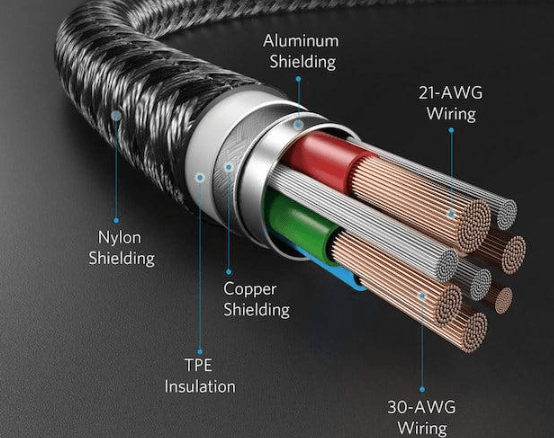
Charging Cable Structure and Material Components
A charging cable is composed of multiple layers, and each layer has a specific function.
| Cable Component | Main Material | Function |
|---|---|---|
| Outer jacket | PVC / TPU / Nylon braid | Protection and durability |
| Insulation layer | PE / PVC materials | Electrical isolation |
| Conductor | Copper | Power transmission |
| Shielding layer | Aluminum foil / copper braid | Signal protection |
| Connector housing | Plastic / metal alloy | Mechanical protection |
| E-marker chip | Semiconductor component | Power identification |
A high-quality cable requires balanced material selection rather than focusing on one component.
For example, a strong outer jacket cannot compensate for poor internal copper conductors.
PVC Charging Cable Material
What Is PVC Cable Material?
PVC (Polyvinyl Chloride) is one of the most widely used materials in charging cables.
It is commonly used because of:
Low production cost
Easy processing
Good insulation properties
Large-scale manufacturing capability
PVC cables are often selected for:
Entry-level accessories
Promotional products
Large-volume orders
Advantages of PVC Charging Cables
| Advantage | Explanation |
|---|---|
| Cost efficiency | Suitable for price-sensitive markets |
| Easy customization | Supports different colors |
| Stable production | Mature manufacturing process |
| Good insulation | Provides electrical protection |
Limitations of PVC Cables
PVC cables may have disadvantages:
Lower flexibility compared with TPU
Easier surface wear
Less premium appearance
For daily heavy-use applications, businesses often consider upgraded materials.
TPU Charging Cable Material
What Is TPU?
TPU (Thermoplastic Polyurethane) is a flexible and durable material commonly used in higher-quality charging cables.
Compared with PVC, TPU provides improved mechanical performance.
Advantages of TPU Charging Cables
TPU offers:
Better flexibility
Higher bending resistance
Improved abrasion resistance
Better temperature performance
Applications include:
Car charging cables
Travel charging cables
Office desk charging cables
Professional accessories
TPU vs PVC Comparison
| Feature | PVC | TPU |
|---|---|---|
| Cost | Lower | Higher |
| Flexibility | Medium | High |
| Durability | Standard | Better |
| Premium feel | Average | Better |
| Application | Mass market | Professional products |
Nylon Braided Charging Cable Material
What Is a Nylon Braided Cable?
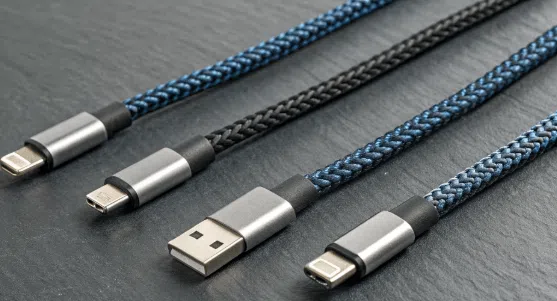
A nylon braided cable uses woven fibers around the outer jacket.
The braid creates an additional protective layer.
It is commonly used for premium products such as:
Fast charging cables
Laptop charging cables
Gaming accessories
Travel products
Advantages of Nylon Braided Cables
Improved Durability
The woven structure protects against:
Scratches
Daily friction
External damage
Better Tangle Resistance
The braided surface reduces cable memory and improves handling.
This is especially useful for:
Travel USB cables
Portable charging accessories
Premium Product Appearance
Many retail brands select braided designs because customers associate them with:
Higher quality
Longer lifespan
Better performance
A professional supplier may provide:
Durable nylon braided Type C charging cable factory
solutions for premium product lines.
Internal Conductor Material Selection
The internal conductor is one of the most important parts of a charging cable.

Copper Conductor
High-quality charging cables normally use copper conductors.
Copper provides:
Excellent electrical conductivity
Stable current transmission
Lower resistance
Wire Gauge and Charging Performance
Thicker conductors can support higher current.
| Cable Power | Typical Application |
|---|---|
| 60W USB-C cable | Phones and tablets |
| 100W USB-C cable | Laptops |
| 240W USB-C cable | High-power devices |
High-power cables require careful conductor design to reduce:
Voltage drop
Heat generation
Charging instability
Shielding Material
Shielding protects the cable from electromagnetic interference.
Common shielding materials include:
Aluminum foil
Copper braid
Drain wire
Good shielding improves:
Data stability
Signal quality
Device compatibility
This is especially important for:
USB4 cables
Video-capable USB-C cables
External storage applications
Connector Material Selection
The connector is one of the most stressed parts of a charging cable.
Common connector materials include:
| Material | Application |
|---|---|
| Nickel plating | Standard products |
| Gold plating | Premium conductivity |
| Aluminum alloy shell | High-end products |
Quality connectors improve:
Plug lifespan
Contact stability
Corrosion resistance
Material Selection by Application
Different markets require different cable structures.
| Application | Recommended Material |
|---|---|
| Promotional cable | PVC |
| Retail charging cable | TPU or braided |
| Premium accessories | Nylon braided |
| Automotive cable | Flexible TPU |
| Laptop charging cable | Reinforced braided |
| Travel cable | Lightweight TPU/braided |
Case Study
US Retail Brand Upgrades Charging Cable Materials for Premium Product Line
Customer Background
A North American electronics retailer planned to upgrade its charging accessory category.
The company sold:
Smartphone accessories
Laptop accessories
Travel electronics
The goal was to replace basic cables with higher-value products.
Customer Challenges
The previous products had problems:
Short lifespan
Frequent customer returns
Poor premium perception
Limited product differentiation
The retailer needed a supplier capable of developing multiple material options.
OSKO Solution
OSKO designed different cable structures based on application requirements.
| Product | Material Solution | Application |
|---|---|---|
| Standard charging cable | PVC structure | High-volume retail |
| Flexible cable | TPU jacket | Automotive and travel |
| Premium USB-C cable | Nylon braided design | Retail upgrade |
| Laptop charging cable | Reinforced conductor + braid | High-power charging |
The project included:
OEM charging cable production
ODM USB cable development
Bulk custom charging cables
Retail USB cable solutions
Selection Guide
How Buyers Choose the Right Charging Cable Material
Define Product Positioning
Before selecting materials, businesses should determine:
Target customer
Price level
Usage environment
Expected lifespan
Match Material With Usage Scenario
Questions to consider:
Is the cable used daily?
Will it be carried frequently?
Does it support high-power charging?
Is appearance important?
Evaluate Supplier Manufacturing Capability
A reliable supplier should support:
Material customization
Cable structure design
Performance testing
Certification support
Important certifications include:
| Certification | Purpose |
|---|---|
| CE | European safety |
| RoHS | Material compliance |
| FCC | US requirements |
| USB-IF | USB performance |
| ISO9001 | Quality management |
Professional suppliers may provide:
CE RoHS certified USB-C cable supplier
USB-IF compliant Type C cable manufacturer
ISO9001 certified braided USB cable factory
FAQ
Which charging cable material is the most durable?
Nylon braided cables combined with strong internal conductors generally provide better durability for heavy daily use
Is TPU better than PVC for charging cables?
TPU provides better flexibility and durability, while PVC is more suitable for cost-sensitive applications.
Why are braided charging cables more expensive?
Braided cables require additional materials and manufacturing processes, but they offer improved durability and premium appearance.
What material is best for fast charging cables?
Fast charging performance depends mainly on conductor design, power rating, and chip compatibility. Premium materials improve reliability and durability.
Do cable materials affect charging speed?
Yes. Internal conductor quality and resistance directly affect charging efficiency, while outer materials mainly affect protection and lifespan.
Summary
Charging cable material selection directly affects product quality, durability, and market positioning.
Key material considerations include:
PVC for cost-effective solutions
TPU for flexible and durable designs
Nylon braid for premium products
Copper conductors for stable charging
Proper shielding for reliable data performance
For businesses sourcing:
OEM charging cables
USB-C cables
Wholesale charging products
Private label accessories
working with an experienced USB cable manufacturer ensures the correct balance between material quality, production cost, and application requirements.
A professional charging cable supplier can provide customized solutions for retail, automotive, office, travel, and consumer electronics markets.
