















Why Do Many Mobile Phones Use USB Type-C Interfaces?
USB Type-C has become the standard charging and data connection interface for modern smartphones because it provides reversible plug design, faster charging capability, higher data transfer performance, and better compatibility with advanced digital devices.
Compared with older USB connectors, the USB Type-C interface provides a more convenient user experience while supporting modern technologies such as USB Power Delivery (USB PD), high-speed data transmission, external displays, and multi-device connectivity.
Today, USB-C is widely used in:
Smartphones
Tablets
Laptops
Gaming devices
Portable monitors
Car charging systems
Smart home equipment
For manufacturers and brands, the growth of USB-C has also created increasing demand for reliable USB-C cable manufacturers and OEM cable solutions.
What Is a USB Type-C Interface?
How Does USB Type-C Work?
USB Type-C, also called USB-C, is a modern connector standard developed by the USB Implementers Forum (USB-IF).
Unlike traditional USB Type-A connectors, USB-C uses a compact 24-pin symmetrical design that supports:
Power transmission
Data communication
Video output
Device charging
Accessory connection
The USB-C connector includes important electrical contacts such as:
VBUS power lines
Ground connections
Data transmission lines
Configuration channels (CC pins)
High-speed signal lanes
This advanced structure allows USB-C cables to support multiple functions through a single connector.
For example, one USB-C cable can be used for:
Charging a smartphone
Connecting a laptop
Transferring files
Connecting external displays
This versatility is one of the main reasons why manufacturers continue adopting USB Type-C technology.

Why Did Smartphones Switch From Micro USB to USB-C?
What Problems Did Older USB Interfaces Have?
Before USB-C became popular, many Android smartphones used Micro USB connectors.
However, Micro USB had several limitations:
1. Non-Reversible Plug Design
Traditional USB connectors had a fixed orientation.
Users needed to check:
Correct direction
Connector position
Plug alignment
This made charging inconvenient, especially in low-light environments.
2. Limited Charging Capability
Older USB interfaces were mainly designed for lower power levels.
With the development of:
Fast charging technology
Larger smartphone batteries
USB Power Delivery
manufacturers needed a connector capable of supporting higher power.
3. Limited Expansion Capability
Modern devices require more than charging.
Users increasingly need:
External displays
Data transfer
Accessories
Docking stations
USB-C provides significantly better expansion capability.
What Are the Main Advantages of USB Type-C?
Why Is USB-C Better for Mobile Phones?
The popularity of USB-C comes from several key advantages.
1. Reversible Connector Design
Why Is USB-C More Convenient?
The biggest user benefit of USB Type-C is its reversible design.
Unlike USB-A and Micro USB:
No front or back direction
Easier connection
Less connector damage caused by incorrect insertion
The oval-shaped USB-C connector allows users to plug in the cable from either side.
This improves daily usability and reduces mechanical stress.
2. Faster Charging Performance
Can USB-C Provide Faster Phone Charging?
Yes.
USB-C supports advanced charging technologies such as:
USB Power Delivery (USB PD)
Programmable Power Supply (PPS)
Fast charging protocols
Depending on the device and charger, USB-C can support significantly higher charging power compared with older USB connections.
Typical applications include:
| Cable Type | Typical Charging Capability |
|---|---|
| Micro USB Cable | Basic charging |
| USB-A to USB-C Cable | Standard fast charging |
| USB-C to USB-C Cable | High-power USB PD charging |
For modern smartphones, a high-quality USB-C charging cable is essential to achieve stable fast charging performance.
Charging speed depends on:
Charger output
Phone charging protocol
Cable current rating
Internal conductor quality
A poor-quality cable may limit charging performance even when using a powerful charger.
3. Higher Data Transfer Capability
Does USB-C Only Support Charging?
No.
USB-C supports both charging and data transmission.
Depending on cable design, USB-C cables may support:
USB 2.0 (480 Mbps)
USB 3.2 (5Gbps–20Gbps)
USB4 (up to 40Gbps)
Different applications require different cable structures.
For example:
| Application | Recommended Cable |
|---|---|
| Phone charging | USB 2.0 USB-C cable |
| File transfer | USB 3.2 USB-C cable |
| External SSD | USB4 cable |
| Professional workstation | High-speed USB-C cable |
This is why professional buyers must evaluate cable specifications instead of only looking at the connector appearance.
4. Support for Video and External Devices
Can USB-C Connect to Monitors?
Yes.
Some USB-C ports support:
DisplayPort Alt Mode
HDMI adapters
Docking stations
External monitors
USB-C can replace multiple traditional ports in modern devices.
This is especially important for:
Laptops
Tablets
Professional workstations
For example, many thin laptops now use USB-C docking solutions to connect:
Power
Display
Network
Accessories
through a single cable.
Why Are USB-C Cables Important for OEM Brands?
Why Is Cable Quality Critical?
Although USB-C connectors look similar, cable performance can vary significantly.
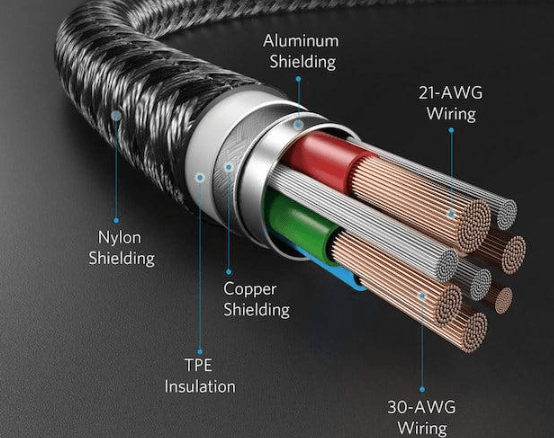
A professional USB-C cable manufacturer must control:
Conductors
High-quality cables use:
Pure copper conductors
Proper AWG sizing
Low resistance design
Shielding
Premium cables use:
Aluminum foil shielding
Copper braid shielding
Twisted signal pairs
to improve:
EMI protection
Signal stability
Data reliability
Connector Design
Important factors include:
Contact plating quality
Connector strength
Strain relief structure
Poor connector design may cause:
Charging interruption
Loose connection
Short product lifespan
What USB-C Cable Specifications Should Buyers Consider?
How Do Businesses Select the Right USB-C Cable?
For OEM and wholesale purchasing, buyers should evaluate:
Charging Requirement
Examples:
100W USB-C PD cable
240W USB PD 3.1 cable
Data Requirement
Choose based on:
Charging only
File transfer
High-speed data
Video output
Material Requirement
Common jacket options:
PVC
Advantages:
Low cost
Easy production
Suitable for:
Mass-market products
TPE
Advantages:
Flexible
Soft touch
Suitable for:
Premium consumer cables
Nylon Braided
Advantages:
High durability
Premium appearance
Suitable for:
High-end accessories
Why Is USB-C Becoming Important in Cars and Smart Homes?
What Are New USB-C Applications?
USB-C is expanding beyond smartphones.
Applications include:
Automotive Systems
USB-C is increasingly used for:
Car charging
Smartphone connectivity
Data transmission
Examples:
CarPlay accessories
Vehicle charging ports
Smart Home Devices
USB-C is also used in:
Smart speakers
Cameras
Smart displays
IoT equipment
The advantage is simple:
One universal connector
More power capability
Better compatibility
OSKO Engineering Case Study: Custom USB-C Cable Development for European Retail Brand
A European electronics distributor contacted OSKO to develop a custom USB-C charging cable for smartphone and tablet accessories.
The customer required:
USB-C to USB-C charging support
Premium retail appearance
60W fast charging capability
RoHS and REACH compliance
Custom packaging
OSKO engineering optimized the cable design with:
High-quality copper conductors
Reinforced connector structure
Durable braided jacket
Production electrical testing
The final solution improved:
Charging stability
Product durability
Customer satisfaction
This project demonstrates why selecting an experienced OEM USB-C cable supplier is important for international brands.
Why Are USB-C Cables Becoming the Global Standard?
What Is the Future of USB Type-C Technology?
The adoption of USB Type-C continues to accelerate because the connector solves many limitations of previous interfaces.
The global electronics industry is moving toward:
Universal charging solutions
Higher charging power
Faster data transfer
Reduced electronic waste
Multi-function connectivity
USB-C supports this transition because one connector can replace multiple traditional interfaces.
For example, a single USB-C charging cable can potentially support:
Smartphone charging
Laptop power delivery
Data synchronization
External display connection
Docking station applications
This flexibility makes USB-C attractive for both consumers and electronics manufacturers.
For businesses, this trend creates increasing demand for:
Custom USB-C cables
USB-C cable wholesale solutions
OEM charging cable manufacturing
High-performance USB-C cable suppliers
How Does USB-C Support Modern Fast Charging Technology?
Why Are USB PD Cables Becoming More Important?
USB Power Delivery (USB PD) has changed how electronic devices charge.
Traditional charging systems were limited by fixed power levels. USB PD allows intelligent communication between:
Charger
Cable
Device
The system automatically negotiates:
Voltage
Current
Power level
Modern USB-C PD cables can support:
| USB-C Cable Type | Typical Application |
|---|---|
| 60W USB-C Cable | Smartphones, tablets, accessories |
| 100W USB-C Cable | Laptops, monitors, high-performance tablets |
| 140W USB-C Cable | New generation laptops |
| 240W USB-C Cable | USB PD 3.1 high-power devices |
For these applications, cable design becomes more important.
A professional USB-C cable manufacturer must consider:
Conductor thickness
Heat control
E-Marker chip technology
Connector durability
Shielding structure
Why Does E-Marker Technology Matter in USB-C Cables?
What Is an E-Marker Chip?
An E-Marker is an intelligent identification chip installed inside some advanced USB-C cables.
It stores information about:
Cable current capability
Power rating
USB specification support
Cable characteristics
E-Marker chips are commonly required for:
5A charging cables
100W USB-C cables
140W USB-C cables
240W USB PD 3.1 cables
Without proper E-Marker communication, a charger may reduce power output to protect the device.
For OEM buyers, confirming E-Marker capability is important when sourcing:
Laptop charging cables
Premium smartphone accessories
High-power USB-C cables
What Quality Standards Should USB-C Cable Manufacturers Follow?
How Can Buyers Evaluate a Reliable USB-C Cable Supplier?
For global buyers, choosing a supplier requires more than comparing prices.
A professional OEM USB-C cable manufacturer should have:
ISO9001 Quality Management System
ISO9001 helps control:
Supplier management
Material inspection
Production procedures
Quality records
Corrective actions
A complete quality system normally includes:
IQC (Incoming Quality Control)
Incoming materials are checked for:
Copper conductor quality
Connector materials
Plastic components
Compliance documents
IPQC (In-Process Quality Control)
Production inspection focuses on:
Cable assembly
Soldering quality
Connector installation
Injection molding
OQC (Outgoing Quality Control)
Final inspection verifies:
Charging performance
Data transfer capability
Cable appearance
Packaging requirements
This process helps international brands maintain consistent product quality.
What Compliance Certifications Should USB-C Cable Buyers Request?
Which Documents Are Important for Global Markets?
Different markets have different compliance expectations.
Professional buyers should request:
| Certification | Purpose |
|---|---|
| RoHS | Restriction of hazardous substances |
| REACH | Chemical compliance for European markets |
| ISO9001 | Quality management system |
| USB-IF Compliance | USB specification verification |
| UL Certification | Electrical safety requirements |
For European buyers, especially distributors in Germany and the Netherlands, RoHS and REACH documentation is often a basic requirement.
For US buyers, safety documentation and reliable manufacturing records are important for retail and commercial distribution.
For Australian buyers, durability, safety, and product reliability are major purchasing considerations.
How Should Brands Choose a USB-C Cable Manufacturer?
What Should Procurement Teams Evaluate?
When selecting a USB-C cable supplier, professional buyers should review five areas.
1. Engineering Capability
Ask:
Can the supplier design USB PD cables?
Can they develop 60W, 100W, or 240W solutions?
Can they support custom cable structures?
Can they provide engineering recommendations?
A capable supplier should understand both:
Electrical design
Mechanical design
2. Material Selection
Important factors include:
Conductors
Premium cables usually use:
Pure copper conductors
Correct AWG sizing
Low-resistance designs
Jackets
Choose according to application:
PVC
Suitable for:
Cost-sensitive products
Large-volume distribution
TPE
Suitable for:
Flexible consumer cables
Premium accessories
Nylon Braided
Suitable for:
Durable charging cables
High-end retail products
3. Testing Capability
A reliable manufacturer should perform:
Electrical testing:
Continuity testing
Resistance testing
Charging verification
Mechanical testing:
Bend testing
Pull-force testing
Connector insertion testing
High-performance testing:
USB PD verification
Signal integrity testing
E-Marker validation
4. OEM Customization Capability
International brands often require:
Custom cable length
Custom colors
Logo printing
Packaging design
Private label production
A professional OEM factory should support:
Prototype development
Sample testing
Mass production
Quality documentation
5. Production Experience
A supplier with experience in global markets understands:
Import requirements
Compliance expectations
Retail packaging standards
Customer quality requirements
This reduces communication costs and production risks.
Why Choose OSKO as Your USB-C Cable Manufacturing Partner?
Professional OEM and ODM USB-C Cable Solutions
OSKO specializes in custom cable manufacturing solutions for global customers.
Our capabilities include:
USB-C fast charging cables
USB PD cables
Custom braided cables
OEM packaging solutions
We support:
Product development
Material selection
Engineering optimization
Mass production
Quality inspection
OSKO Manufacturing Advantages
Engineering Support
We help customers select:
Correct conductor specifications
Suitable jacket materials
Charging solutions
Product structures
Quality Control
Production follows controlled processes:
Incoming inspection
Manufacturing monitoring
Electrical testing
Final inspection
Global Market Support
OSKO provides solutions for:
US distributors
European brands
Australian retailers
International electronics companies
Conclusion
USB Type-C has become the preferred interface for modern smartphones because it combines convenience, charging capability, data performance, and future expansion potential.
The main advantages of USB-C include:
Reversible connector design
Faster charging through USB PD
Higher data transfer capability
Support for video output
Compatibility with modern electronics
However, the performance of USB-C depends heavily on cable quality.
A professional USB-C cable manufacturer must control:
Conductor design
Material selection
Connector quality
E-Marker technology
Testing procedures
Compliance management
For brands, distributors, and OEM buyers, selecting a reliable custom USB-C cable supplier helps reduce product risks and create competitive charging solutions for global markets.
As the electronics industry continues moving toward universal connectivity, USB-C cables will remain a critical product category for consumer electronics, automotive systems, and smart devices.
FAQ
1. Why do mobile phones use USB Type-C instead of Micro USB?
Mobile phones use USB Type-C because it provides a reversible connector design, higher charging capability, faster data transfer, and better compatibility with modern electronic devices.
2. Is USB-C better than USB-A for charging phones?
Yes. USB-C generally supports higher power delivery and modern fast charging technologies. However, charging speed depends on the charger, phone compatibility, and cable specifications.
3. Can all USB-C cables support fast charging?
No. USB-C is only the connector type. Fast charging depends on conductor size, cable current rating, USB PD support, and whether the cable includes an E-Marker chip.
4. What is the difference between USB-C charging cables and USB-C data cables?
USB-C charging cables may only support power delivery, while USB-C data cables include additional wiring for file transfer and higher-speed communication.
5. What should businesses check before buying USB-C cables wholesale?
Businesses should evaluate charging power capability, conductor quality, AWG size, certification documents, factory quality systems, testing capability, and OEM customization options.
6. How do I choose a reliable USB-C cable manufacturer?
Choose a supplier with engineering capability, ISO9001 quality management, RoHS and REACH compliance, production testing procedures, OEM experience, and proven international market experience.
7. Are braided USB-C cables better than standard cables?
Braided USB-C cables usually provide better abrasion resistance and durability, making them suitable for premium products. However, charging performance depends mainly on internal electrical design rather than the outer jacket alone
