















Introduction: Does iPhone Use USB-C?
For many years, iPhone users relied on Apple’s proprietary Lightning connector for charging, data transfer, and accessory connections. However, with the launch of the iPhone 15 series, Apple officially moved from Lightning to USB-C, creating a major change in the smartphone accessory market.
So, does iPhone use USB-C now? The answer is yes. Starting with the iPhone 15 lineup, Apple introduced USB-C ports across its new iPhone models, including the iPhone 15, iPhone 15 Plus, iPhone 15 Pro, and iPhone 15 Pro Max. The latest iPhone generations continue using USB-C, giving users better compatibility with modern charging solutions.
This transition brings several advantages, including wider device compatibility, easier cable management, improved accessory support, and faster data transfer capabilities on selected models. However, not every USB-C cable provides the same charging speed or performance. Choosing the right USB-C cable for iPhone is essential for achieving safe and efficient charging.
For consumers, retailers, and electronic accessory buyers, understanding the differences between USB-C cables, charging standards, and performance specifications helps avoid compatibility problems and improves the overall user experience.

Which iPhone Models Use USB-C?
The question “Which iPhone has USB-C?” became one of the most searched topics after Apple’s connector transition.
Apple introduced USB-C starting from the iPhone 15 series released in 2023. The following models use USB-C ports:
iPhone 15
iPhone 15 Plus
iPhone 15 Pro
iPhone 15 Pro Max
iPhone 16 series and newer models
Older models, including:
iPhone 14 series
iPhone 13 series
iPhone 12 series
iPhone SE (Lightning versions)
still use Apple’s Lightning connector.
The move to USB-C allows iPhone users to share charging accessories with other modern devices such as MacBooks, iPads, Android smartphones, tablets, and laptops.
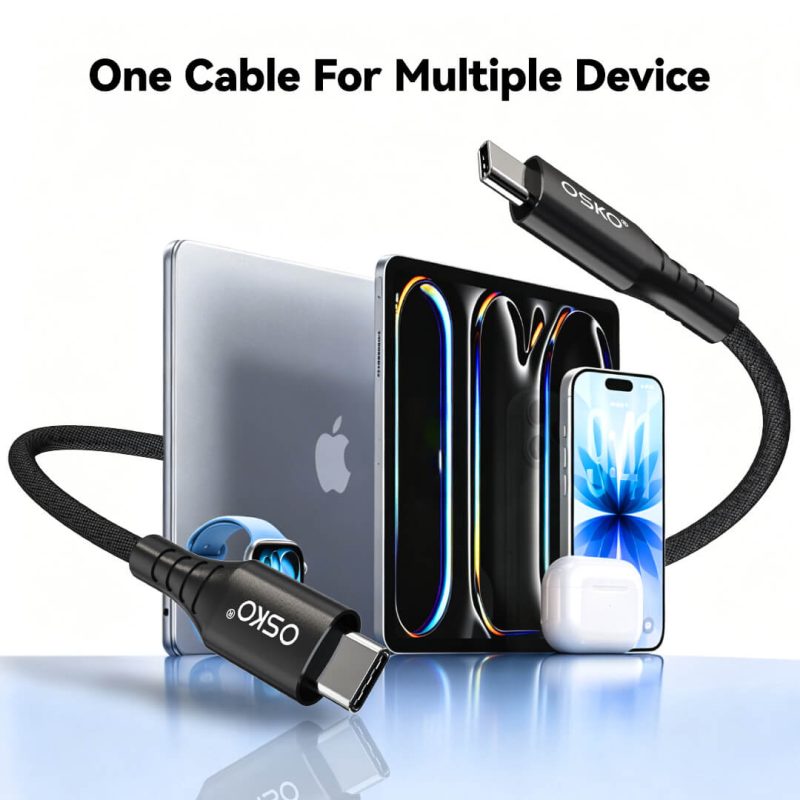
For example, a user traveling with a USB-C to USB-C charging cable can potentially charge multiple devices with one cable instead of carrying separate Lightning, USB-C, and laptop charging cables.
This change is especially beneficial for users in markets such as the United States, Germany, Australia, and the Netherlands, where USB-C charging accessories have become increasingly common in offices, homes, and travel environments.
Why Did Apple Switch iPhone from Lightning to USB-C?
Apple’s decision to adopt USB-C was influenced by several technical and regulatory factors.
1. USB-C Is Becoming the Global Charging Standard
USB-C has become the preferred connector for modern electronics because of its versatility.
Unlike Lightning, USB-C is an open industry standard supported by many manufacturers, including smartphone, laptop, monitor, and accessory brands.
A single USB-C ecosystem can support:
Smartphone charging
Laptop power delivery
High-speed data transfer
External display connection
Docking stations
Gaming accessories
This makes USB-C a more flexible solution for modern consumers and businesses.
2. European Union Regulation Encouraged USB-C Adoption
One major reason behind Apple’s transition was the European Union’s common charging standard regulation.
The EU required many consumer electronic devices sold in its market to adopt USB-C charging to reduce electronic waste and simplify charging solutions.
For manufacturers selling products internationally, adopting USB-C became a practical business decision because maintaining separate Lightning and USB-C product versions increased production complexity.
3. Improved Device Compatibility
Before USB-C adoption, iPhone users often needed separate accessories:
USB-C cable for MacBook
USB-C cable for iPad
Different cables for Android devices
With USB-C, users can build a more unified charging setup.
For example:
A professional user may use one 100W USB-C cable for a laptop, tablet, and smartphone, reducing the number of cables needed in a workspace.
USB-C vs Lightning: What Are the Main Differences?
Although both USB-C and Lightning can charge Apple devices, they are different technologies.
Charging Capability
USB-C has a significant advantage in power delivery.
USB-C supports USB Power Delivery (USB PD), allowing compatible cables and chargers to deliver higher power levels.
Depending on the cable specification:
USB-C PD cables can support 60W, 100W, or even 240W charging
Lightning cables typically support lower power levels
For iPhone users, a high-quality USB-C to USB-C cable for iPhone charging paired with a compatible charger provides a more flexible charging solution.
However, actual charging speed depends on:
iPhone model
Charger output
Cable power rating
Charging protocol compatibility
A high-wattage cable does not automatically force an iPhone to charge faster if the device itself has a charging limit.
Data Transfer Speed
USB-C also provides advantages in data transfer.
Different iPhone models have different USB specifications:
iPhone 15 and iPhone 15 Plus
These models use USB 2.0 speeds:
Data transfer: up to 480 Mbps
iPhone 15 Pro and iPhone 15 Pro Max
These models support USB 3:
Data transfer: up to 10 Gbps
This difference is important for professional users who frequently transfer:
4K videos
High-resolution photos
Large project files
For photographers, video creators, and business users, choosing the correct high-speed USB-C cable for iPhone data transfer can significantly reduce file transfer time.
Are All USB-C Cables Compatible With iPhone?
A common misunderstanding is that every USB-C cable works the same way.
The answer is no.
Although the connector shape is identical, USB-C cables can have very different internal designs and capabilities.
A USB-C cable may support:
Charging only
Charging + USB 2.0 data transfer
High-speed USB 3.x data transfer
USB4 performance
Display output
Higher power delivery
For example:
A basic USB-C cable may support:
60W charging
480 Mbps data transfer
A premium USB-C cable may support:
100W or 240W charging
Higher-speed data transmission
Better shielding
More durable construction
Therefore, when selecting a USB-C cable for iPhone 15 or iPhone 16, buyers should check the cable specifications instead of choosing only based on connector type.
USB-C Cable Selection Guide for iPhone Users
Choosing the right USB-C cable for iPhone 15, iPhone 16, and future iPhone models is not only about finding a cable with a matching connector. A reliable charging cable must balance power delivery, data performance, durability, safety, and compatibility.
Many consumers purchase USB-C cables based only on appearance or price, but different cable structures can significantly affect charging efficiency and product lifespan.
For personal users, retailers, and professional buyers, the following factors are essential when selecting a high-quality USB-C cable.
1. Check USB Power Delivery (USB PD) Support
The most important factor for fast charging is whether the cable supports USB Power Delivery (USB PD).
USB PD is a smart charging protocol that allows the charger, cable, and device to communicate and determine the optimal power level.
For iPhone charging, a quality USB-C cable should support:
Stable power transmission
Safe current control
Compatibility with USB PD chargers
Common USB-C cable power ratings include:
60W USB-C Cable
Suitable for:
iPhone 15 / iPhone 16
iPads
Smartphones
Small tablets
Accessories
A 60W USB-C charging cable is one of the most popular choices for everyday consumers because it provides enough power for mobile devices while maintaining a compact design.
100W USB-C Cable
Suitable for:
MacBook Air
MacBook Pro
Gaming laptops
High-power tablets
A 100W USB-C cable provides more flexibility for users who want one cable for multiple devices.
240W USB-C Cable
The latest USB PD 3.1 standard allows USB-C cables to support up to 240W power delivery.
These cables are mainly designed for:
High-performance laptops
Professional workstations
Future high-power devices
For iPhone users, 240W capability is not required, but it demonstrates the scalability of the USB-C ecosystem.
2. Consider Cable Material and Durability
The lifespan of a USB-C cable depends heavily on its construction quality.
Low-cost charging cables often fail because of:
Weak connector joints
Poor internal copper conductors
Limited bending resistance
Weak outer insulation
A premium USB-C cable usually includes:
Nylon Braided Exterior
Braided nylon improves:
Abrasion resistance
Flexibility
Daily durability
Tangle resistance
For users who charge devices frequently at home, offices, or vehicles, a braided USB-C cable can provide a longer service life.
Reinforced Connector Design
The connector area experiences the most stress during daily use.
High-quality cables often use:
Reinforced cable joints
Stronger metal shells
Improved strain relief structures
This helps prevent common problems such as:
Cable separation
Connector damage
Intermittent charging
3. Choose the Correct Cable Length
Cable length directly affects convenience and charging performance.
Common USB-C cable lengths include:
3ft USB-C Cable
Best for:
Desk charging
Office environments
Power banks
Close-range charging
A 3ft cable keeps workspaces clean and reduces unnecessary cable clutter.
6ft USB-C Cable
Best for:
Bedroom charging
Sofa charging
Travel use
A 6ft USB-C cable provides more flexibility when power outlets are far away.
10ft USB-C Cable
Best for:
Large rooms
Workstations
Conference environments
However, longer cables require better internal construction to maintain stable power delivery.
4. Understand Data Transfer Requirements
Not every iPhone user needs high-speed data transfer, but professionals should pay attention to cable specifications.
USB-C cables can support different data speeds:
| Cable Type | Data Speed |
|---|---|
| USB 2.0 USB-C Cable | Up to 480 Mbps |
| USB 3.2 USB-C Cable | Up to 10 Gbps |
| USB4 Cable | Up to 40 Gbps |
For users who mainly charge an iPhone, USB 2.0 performance may be enough.
However, photographers, content creators, and business users transferring large files should choose high-speed USB-C cables.
Engineering Case Study: Developing a Reliable USB-C Cable Solution for iPhone Retail Markets
A European electronics distributor approached OSKO looking for a USB-C cable solution for the growing iPhone 15 and iPhone 16 accessory market.
The buyer’s requirements included:
Compatibility with Apple USB-C devices
Stable fast charging performance
Retail-quality appearance
Long service life
Competitive wholesale pricing
During product development, OSKO’s engineering team focused on several key areas:
Electrical Performance Testing
The cable design was optimized with:
High-purity copper conductors
Improved power transmission efficiency
Stable USB PD charging performance
The final product supported reliable 60W charging performance for smartphones, tablets, and compatible USB-C devices.
Mechanical Reliability Testing
To improve durability, OSKO performed:
Bend testing
Connector stress testing
Plug/unplug cycle testing
The braided nylon structure was selected to provide better protection for daily consumer usage.
Procurement Result
The distributor successfully launched the USB-C cable product line in European retail channels, targeting users upgrading from Lightning iPhones to USB-C models.
From a procurement perspective, selecting a professional USB cable manufacturer helped reduce:
Product return rates
Compatibility complaints
Quality control risks
This demonstrates why OEM/ODM capability is important when sourcing USB-C charging cables for global markets.
How USB-C Cable Manufacturers Ensure Quality
For professional buyers, cable quality depends on more than appearance.
A reliable USB-C cable manufacturer should have quality control processes covering:
Material Inspection
Manufacturers evaluate:
Copper conductor quality
Connector materials
Outer jacket durability
Shielding performance
Charging Performance Testing
Testing verifies:
Voltage stability
Current capacity
USB PD communication
Heat control
Compatibility Testing
Professional manufacturers test cables with:
Smartphones
Tablets
Laptops
USB-C chargers
Car charging systems
This ensures customers receive products that work reliably across different environments.
Why Choose OSKO USB-C Cable Solutions?
As an experienced USB cable manufacturer, OSKO focuses on developing reliable charging solutions for global markets, including North America, Europe, Australia, and other regions.
OSKO provides:
USB-C to USB-C cables
USB-A to USB-C cables
USB-C to Lightning cables
OEM and ODM customization
Custom lengths and packaging
Bulk production solutions
For retailers, distributors, and brand owners, OSKO helps create USB-C cable products that meet market demands for performance, durability, and competitive pricing.
FAQ: Does iPhone Use USB-C?
Does iPhone 15 use USB-C?
Yes. The iPhone 15 series was the first iPhone generation to replace the Lightning port with USB-C. All iPhone 15 models use USB-C charging ports, allowing users to connect USB-C chargers, cables, and accessories.
Does iPhone 16 use USB-C?
Yes. iPhone 16 models continue using USB-C ports. Users can use USB-C charging cables for charging, data transfer, and compatible accessories.
Can I use any USB-C cable to charge my iPhone?
Most USB-C cables can physically connect to iPhones with USB-C ports, but charging performance depends on cable specifications. For faster charging, choose a USB-C cable that supports USB Power Delivery and matches your charger requirements.
Is USB-C faster than Lightning for iPhone?
USB-C offers advantages in charging flexibility, accessory compatibility, and data transfer capability. However, actual charging speed depends on the iPhone model, charger power, and cable specifications.
What USB-C cable is best for iPhone 15?
A high-quality USB-C to USB-C cable supporting USB PD charging is recommended for iPhone 15. A 60W braided USB-C cable provides sufficient performance for most iPhone users.
Can I use a 100W USB-C cable with iPhone?
Yes. A 100W USB-C cable can safely charge an iPhone because USB Power Delivery allows devices to negotiate the required power level. The iPhone will only draw the power it supports.
Do USB-C cables support fast charging automatically?
No. Not every USB-C cable supports fast charging. Fast charging requires compatibility between the cable, charger, and device. Look for USB PD support and appropriate power ratings.
Can USB-C iPhone cables transfer data?
Yes. USB-C cables can transfer data between iPhones and computers. However, transfer speed depends on the cable standard and iPhone model.
Summary
The answer to “Does iPhone use USB-C?” is clear: modern iPhones have officially moved to USB-C starting with the iPhone 15 series.
This transition provides users with:
Greater accessory compatibility
More flexible charging options
Improved cable standardization
Better support for modern devices
However, choosing the correct USB-C cable remains important. Different cables have different charging capacities, data speeds, and durability levels.
For consumers, selecting a reliable USB-C charging cable improves daily convenience. For retailers and distributors, working with an experienced OEM USB cable manufacturer ensures consistent quality and market competitiveness.
OSKO continues to develop professional USB-C charging solutions designed for global customers, helping brands and businesses deliver reliable cable products.
Contact Information
OSKO – Professional USB Cable Manufacturer & OEM/ODM Supplier
Products:
USB-C Fast Charging Cable
Custom USB Cable Solutions
OEM / ODM customization available for wholesalers, distributors, and electronics brands.
Contact OSKO for bulk USB-C cable solutions and product customization.
