















Introduction
Choosing the right iPhone 16 USB-C Cable has become increasingly important as Apple continues expanding the USB-C charging ecosystem. Modern iPhone users now require charging solutions that provide not only power delivery but also reliable connectivity, durability, and compatibility with different charging environments.
The iPhone 16 series uses USB-C connectivity, allowing users to connect with:
USB-C power adapters
Laptop charging systems
Portable chargers
Vehicle charging solutions
Professional workstations
Although many USB-C cables appear identical, their internal engineering can vary significantly. A reliable iPhone Charging Cable requires careful design of:
Conductors
Connector structure
Power transmission capability
Signal protection
Mechanical durability
For consumers, cable quality directly affects:
Charging speed
Daily usability
Product lifetime
For electronics brands and procurement teams, developing an iPhone accessory cable requires:
Stable manufacturing
Consistent quality control
Material optimization
Retail-ready product design
OSKO specializes in OEM and ODM USB cable manufacturing, supporting global electronics brands with customized USB-C Charging Cable solutions through engineering development and quality management.
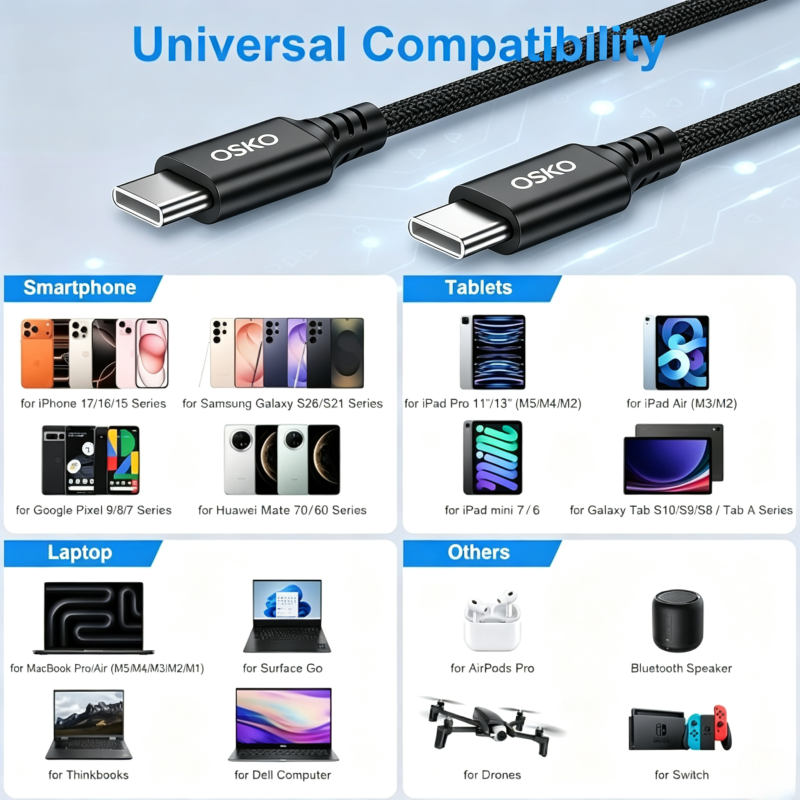
Material Science & Dielectric Properties
Engineering Requirements of iPhone 16 USB-C Cable
A professional iPhone 16 USB-C Cable must balance charging performance, durability, and user convenience.
The cable structure includes multiple layers:
| Component | Function | Engineering Importance |
|---|---|---|
| Copper conductor | Transfers electrical power | Controls charging efficiency |
| Insulation material | Separates internal wires | Ensures electrical safety |
| Shielding layer | Protects signal quality | Reduces interference |
| USB-C connector | Connects devices | Ensures compatibility |
| Outer jacket | Protects cable | Improves durability |
| Strain relief | Reduces bending stress | Extends product lifespan |
USB-C Power Delivery and Fast Charging Performance
Understanding iPhone 16 Charging Requirements
The charging experience of iPhone 16 depends on cooperation between:
Smartphone
Charger
Cable
A high-quality Fast Charging Cable helps maintain stable power transfer by controlling:
Electrical resistance
Current transmission
Heat generation
A suitable cable should match:
Charger output capability
Device charging requirements
Usage environment
USB-C to USB-C Cable Advantages
The most common configuration for iPhone 16 charging is the USB-C to USB-C Cable.
Advantages include:
Compatibility with modern USB-C adapters
Support for USB Power Delivery
Better integration with laptops and tablets
Universal charging ecosystem support
Common usage scenarios:
| Application | Benefit |
|---|---|
| Home charging | Daily smartphone charging |
| Office charging | Desktop workspace connection |
| Travel | Multi-device charging |
| Laptop connection | Cross-device compatibility |
Material Selection and Cable Durability
Copper Conductor Design
The internal conductor directly affects:
Charging efficiency
Heat generation
Voltage stability
High-quality cable designs focus on:
Optimized copper structure
Stable electrical resistance
Consistent production performance
For retail products, reliable conductor design reduces:
Charging interruptions
Customer complaints
Product returns
Outer Jacket Material Engineering
The external cable material determines:
Flexibility
Wear resistance
User experience
Common materials include:
| Material | Characteristics |
|---|---|
| PVC | Cost-effective and durable |
| TPE | Flexible and lightweight |
| Nylon braided | Premium appearance and abrasion resistance |
For premium Retail USB Cable products, braided materials are often selected because they provide enhanced durability and visual appeal.
Connector Reliability Design
Improving Daily Plugging Performance
iPhone charging cables experience frequent:
Plugging
Unplugging
Bending
Transportation
Weak connector designs may lead to:
Loose connections
Internal wire damage
Charging failures
Professional designs include:
Reinforced connector housing
Improved solder structure
Strong strain relief
Mechanical durability testing

Data Transmission Capability
Charging Cable vs Data Cable
A USB-C cable can have different performance levels depending on internal design.
Applications requiring data transmission include:
Photo transfer
Video transfer
Device backup
Computer connection
A professional USB-C Charging Cable design should clearly define:
Charging capability
Data transfer performance
Target application
This helps brands create products that match customer expectations.
Case Study: iPhone 16 USB-C Cable Development for an Australian Mobile Accessory Brand
Customer Background
An Australian consumer electronics brand planned to launch a new Apple accessory product line after the introduction of USB-C connectivity across the latest iPhone models.
The company distributed products through:
Online retail platforms
Mobile accessory stores
Consumer electronics channels
The customer needed a reliable iPhone 16 USB-C Cable solution with:
Stable charging performance
Premium retail appearance
Competitive production cost
Long-term supply capability
Engineering Challenges
1. Improving Charging Stability
During supplier evaluation, the customer found some existing products had:
Different charging performance between batches
Increased temperature during long use
Unstable compatibility with chargers
The product required better electrical control.
2. Meeting Retail Durability Requirements
The target customers expected daily reliability.
The cable needed to withstand:
Frequent connection cycles
Portable use
Repeated bending
3. Maintaining Production Consistency
The procurement team required:
Stable quality
Low defect rate
Consistent appearance
Reliable delivery schedule
OSKO Engineering Solution
Electrical Performance Optimization
OSKO developed a customized cable structure including:
Optimized copper conductor design
Stable internal wiring
Improved connector assembly
This improved:
Charging reliability
Electrical consistency
Product Customization Support
OSKO provided:
Cable length options
Material selection
Color customization
Retail packaging solutions
Supporting the customer’s positioning in the consumer electronics market.
Quality Control Process
| Test Item | Purpose |
|---|---|
| Charging performance test | Verify power stability |
| Resistance test | Control electrical efficiency |
| Temperature test | Evaluate thermal performance |
| Bend test | Confirm mechanical durability |
| Connector test | Verify insertion reliability |
| Appearance inspection | Maintain retail quality |
The final product helped the customer introduce a reliable iPhone 16 charging accessory for the Australian market.
Selection Guide: How to Choose iPhone 16 USB-C Cable
1. Check Charging Requirements
Before selecting a cable, evaluate:
Charger power output
Required charging speed
Daily usage environment
2. Select the Correct Cable Type
USB-C to USB-C Cable
Recommended for:
iPhone 16
USB-C chargers
Laptop charging environments
USB-A to USB-C Cable
Suitable for:
Older charging systems
Vehicle USB ports
Existing USB-A accessories
3. Evaluate Product Quality
Important factors include:
Conductor quality
Connector strength
Cable flexibility
Material durability
4. Choose an Experienced OEM Supplier
For brands developing Apple-compatible accessories, supplier capability is critical.
A professional OEM USB Cable manufacturer should provide:
Engineering support
Product customization
Quality testing
Packaging solutions
Bulk production capability
OSKO supports global brands from product development to mass production.
FAQ
Does iPhone 16 use a USB-C cable?
Yes. The iPhone 16 series uses USB-C connectivity for charging and data applications.
Is every USB-C cable suitable for iPhone 16?
Most USB-C cables can provide basic charging, but performance depends on cable design, materials, and specifications.
What is the best USB-C cable for iPhone 16?
A reliable cable should provide:
Stable charging
Durable connectors
Quality materials
Appropriate power support
Can iPhone 16 USB-C cable transfer data?
Yes. Depending on cable specifications, USB-C cables can support data transfer between iPhone 16 and other devices.
Can OSKO manufacture iPhone 16 USB-C cables?
Yes. OSKO provides OEM and ODM solutions including:
iPhone Charging Cable
USB-C Charging Cable
Fast Charging Cable
Retail USB Cable
Custom USB-C cable products
Summary
A reliable iPhone 16 USB-C Cable requires careful engineering beyond simple connector compatibility. Charging performance, material selection, connector durability, and production consistency determine the real user experience.
For consumers, a professionally designed cable provides:
Stable charging
Better durability
Reliable daily performance
For electronics brands and procurement teams, selecting an experienced OEM partner helps create competitive products with consistent quality and stable supply.
OSKO provides professional OEM and ODM USB-C Charging Cable solutions, including iPhone charging cables, fast charging cables, USB-C to USB-C cables, and customized retail products.
Through engineering optimization, material selection, and strict quality control, OSKO helps global brands develop reliable charging solutions for modern Apple devices.
Contact Information
OSKO USB Cable Manufacturing Solutions
OSKO specializes in:
OEM USB Cable Manufacturing
ODM USB-C Cable Development
iPhone Charging Cable Solutions
Fast Charging Cable Production
Retail USB Cable Manufacturing
For electronics brands, distributors, and procurement teams requiring reliable Apple-compatible charging products, OSKO provides professional engineering support from product development to mass production.
