
Introduction
Choosing the right 100W USB-C Cable has become increasingly important as modern electronic devices require higher power delivery, faster charging speeds, and more reliable connectivity. With USB-C Power Delivery technology becoming widely adopted, many laptops, monitors, docking stations, and professional devices now depend on high-performance USB-C cables for stable operation.
Compared with lower-power charging cables, a 100W USB-C cable must handle higher electrical loads while maintaining:
Stable current transmission
Controlled heat generation
Reliable device communication
Long-term mechanical durability
A high-power cable is commonly used in applications such as:
Business laptops
Professional workstations
USB-C monitors
Docking stations
Creative equipment
High-performance mobile devices
However, selecting a reliable USB-C Charging Cable requires more than checking the 100W label. The internal engineering design determines whether the cable can actually deliver consistent performance.
Key factors include:
Conductor material
Cable resistance
E-marker chip configuration
Thermal design
Connector reliability
Manufacturing consistency
For electronics brands and procurement teams, a professional supplier must provide not only production capability but also engineering support to ensure product reliability.
OSKO specializes in OEM and ODM USB cable manufacturing, helping global electronics brands develop high-power charging solutions through material optimization, electrical testing, and customized production.
Material Science & Dielectric Properties
Engineering Requirements of 100W USB-C Cable
A 100W USB-C Cable operates under higher power requirements compared with standard charging cables.
The electrical relationship is:
Power (W) = Voltage (V) × Current (A)
To support 100W charging, the cable structure must efficiently transfer current while minimizing energy loss.
The main engineering factors include:
| Component | Function | Importance for 100W Applications |
|---|---|---|
| Copper conductor | Transfers electrical power | Controls resistance and efficiency |
| Insulation material | Separates conductors | Ensures electrical safety |
| Shielding layer | Reduces interference | Improves signal stability |
| E-marker chip | Communicates power capability | Enables high-power negotiation |
| Outer jacket | Protects cable structure | Improves durability |
| Connector assembly | Provides device connection | Ensures long-term reliability |
E-Marker Technology and Power Delivery
Why E-Marker Chips Matter
For high-power USB-C applications, E-marker technology plays an important role.
An E-marker chip allows communication between:
Charger
Cable
Device
It provides information about:
Cable current capability
Power support level
USB-C specifications
Without proper cable identification, devices may limit charging power for safety reasons.
A professional USB Power Delivery Cable requires correct E-marker configuration to achieve reliable 100W charging performance.
Conductor Design and Electrical Performance
Reducing Resistance for High Power Charging
At higher power levels, cable resistance becomes increasingly important.
Excessive resistance may result in:
Voltage drop
Reduced charging efficiency
Additional heat generation
To improve performance, manufacturers optimize:
Copper conductor size
Copper purity
Internal wire arrangement
Cable length design
For example, a 100W laptop charging application requires more advanced conductor engineering than a basic smartphone charging cable.

Thermal Management for High Power Applications
Controlling Heat During 100W Charging
High-power charging generates more heat than standard charging.
A reliable cable must manage:
Current flow
Electrical resistance
Heat dissipation
Important design elements include:
Proper conductor selection
Quality insulation materials
Optimized internal structure
Thermal performance is especially important for:
Long charging sessions
Laptop charging
Professional workstation environments
USB-C to USB-C Cable Applications
Why USB-C to USB-C Is Preferred for 100W
Most 100W applications use USB-C to USB-C Cable designs because modern devices increasingly adopt USB-C charging ports.
Common applications include:
| Application | Requirement |
|---|---|
| Laptop charging | Stable high-power delivery |
| Monitor power | Continuous operation |
| Docking station | Power and data capability |
| Professional devices | Reliable long-term performance |
A high-quality USB-C to USB-C solution provides better compatibility with modern USB PD ecosystems.
Material Selection and Durability
Outer Jacket Design
High-power cables are often used frequently in professional environments.
The outer material affects:
Flexibility
Wear resistance
User experience
Common materials include:
| Material | Characteristics |
|---|---|
| PVC | Cost-effective and durable |
| TPE | Flexible and lightweight |
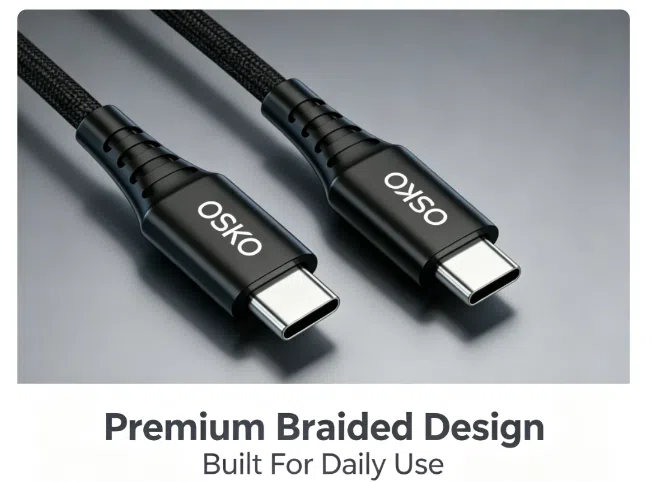
| Nylon braided | Premium appearance and abrasion resistance |
The correct material depends on the target market and application.
Connector Reliability
Connector failure is one of the most common cable issues.
Professional cable designs improve reliability through:
Reinforced connector housing
Strong solder joints
Improved strain relief
Insertion cycle testing
For retail and professional products, connector durability directly affects customer satisfaction.
Case Study: 100W USB-C Cable Development for a Dutch Professional Display Equipment Brand
Customer Background
A Netherlands-based professional display equipment company developed a new USB-C monitor solution for modern business environments.
The product ecosystem included:
USB-C monitors
Laptop docking systems
Professional workstation accessories
The company needed a high-performance cable capable of supporting:
100W power delivery
Stable device connection
Long operating periods
Professional installation requirements
Their purchasing team was searching for a supplier with strong engineering capability and consistent manufacturing quality.
Engineering Challenges
1. Maintaining Stable High-Power Performance
During initial testing, conventional USB-C cables showed:
Increased temperature during operation
Reduced charging stability
Performance variation between suppliers
The customer required improved thermal and electrical performance.
2. Supporting Professional Work Environments
Unlike consumer charging scenarios, professional installations require:
Longer operating hours
Reliable connection
Consistent performance
The cable needed to function continuously in office environments.
3. Achieving Production Consistency
The procurement team required:
Stable electrical parameters
Reliable E-marker performance
Consistent quality across production batches
OSKO Engineering Solution
High-Power Electrical Optimization
OSKO developed a customized cable structure with:
Optimized copper conductors
Controlled electrical resistance
Appropriate E-marker configuration
This improved:
Power transmission efficiency
Charging stability
Long-term reliability
Enhanced Mechanical Structure
OSKO improved:
Connector reinforcement
Cable flexibility
Outer jacket durability
to support frequent professional use.
Quality Testing Process
| Test Item | Purpose |
|---|---|
| 100W power test | Verify charging capability |
| Resistance test | Confirm electrical performance |
| Temperature test | Evaluate thermal control |
| E-marker verification | Confirm communication |
| Bend test | Check mechanical durability |
| Batch inspection | Maintain consistency |
The final solution enabled the customer to launch a reliable high-power USB-C accessory for professional display applications.
Selection Guide: How to Choose a 100W USB-C Cable
1. Confirm Device Power Requirements
Before purchasing, evaluate:
Laptop power requirement
Charger output
Required charging speed
A 100W cable is suitable for many professional devices but should match the actual application.
2. Check USB PD Compatibility
A reliable 100W cable should support:
USB Power Delivery
Correct E-marker identification
Stable communication between devices
3. Consider Cable Length
Longer cables require stronger engineering.
| Length | Application |
|---|---|
| 1m | Portable charging |
| 1.5m | Desk charging |
| 2m+ | Professional workspace |
4. Select an Experienced OEM Supplier
For businesses developing high-power cables, supplier capability is essential.
A professional OEM USB Cable manufacturer should provide:
Product engineering
Material selection
Electrical testing
Customized specifications
Bulk production support
OSKO supports global brands from concept development to mass production.
FAQ
Can a 100W USB-C cable charge a laptop?
Yes. Many laptops supporting USB-C Power Delivery can use a 100W USB-C cable for charging.
Is a 100W cable better than a 60W cable?
A 100W cable supports higher power applications, but the best choice depends on the device requirements.
Does every USB-C cable support 100W charging?
No. High-power charging requires appropriate conductor design, certification, and E-marker technology.
Can a 100W USB-C cable support data transfer?
Yes, depending on the cable specification. Some cables are designed for both charging and data transmission.
Can OSKO customize 100W USB-C cables?
Yes. OSKO provides OEM and ODM solutions including cable design, materials, lengths, connectors, packaging, and electrical specifications.
Summary
A 100W USB-C Cable is designed for high-power charging applications including laptops, monitors, docking stations, and professional electronic devices.
However, achieving reliable 100W performance requires advanced engineering beyond simply increasing power ratings. Conductor design, E-marker technology, thermal management, connector quality, and manufacturing consistency all determine real-world performance.
For electronics brands and procurement teams, choosing an experienced OEM partner helps ensure reliable products and stable supply chains.
OSKO provides professional OEM and ODM USB-C Charging Cable solutions, including 100W cables, fast charging cables, USB-C to USB-C cables, and customized high-power cable products.
Through engineering development, material optimization, and strict quality control, OSKO helps global brands create reliable charging solutions for modern electronic devices.
Contact Information
OSKO USB Cable Manufacturing Solutions
OSKO specializes in:
OEM USB Cable Manufacturing
ODM USB-C Cable Development
100W USB-C Cable Solutions
High Power USB Cable Production
USB-C to USB-C Cable Manufacturing
Custom Charging Cable Solutions
For electronics brands, distributors, and procurement teams requiring reliable high-power charging products, OSKO provides professional engineering support from product design to mass production.