















Introduction
This case study shows how we helped a B2B brand transform a standard USB-C cable idea into a fully customized OEM product line, covering engineering design, PD performance optimization, durability upgrades, and retail-ready packaging for global distribution.
The goal was not only to manufacture cables, but to build a scalable, brand-owned USB-C product ecosystem suitable for Amazon, wholesale, and retail channels.
Request Full OEM Case Study / Get Custom USB-C Spec Sheet / Start Private Label Development
Client Background
The client was a cross-border electronics brand operating in the US and EU markets, primarily selling charging accessories on Amazon and Shopify.
Before optimization, they faced several limitations:
Low differentiation in a saturated USB-C cable market
Heavy price competition with 60W standard cables
High return rate due to inconsistent charging performance
Lack of OEM identity (no strong brand positioning)
Limited scalability for premium product expansion
Their goal was to develop a custom USB-C cable product line that could support higher pricing and long-term brand positioning.
Key Challenges
1. Product Commoditization
Most existing USB-C cables were visually and technically identical, making it difficult to justify premium pricing.
2. Weak Performance Stability
Charging inconsistency across devices (laptops, phones, tablets) affected customer satisfaction.
3. Limited OEM Control
No control over materials, PD performance, or packaging system.
4. High Return Rate Pressure
Returns were mainly caused by overheating, slow charging perception, and cable durability issues.
5. Lack of Scalable SKU Strategy
No structured way to expand product line (length, wattage, materials).
Our Custom USB-C Cable Manufacturing Solution
We implemented a full-cycle OEM manufacturing strategy covering engineering, quality control, and brand positioning.
1. Product Engineering Redesign (USB-C PD Optimization)
We upgraded the product from standard USB-C cables to a structured PD performance system:
USB-C PD support upgraded to 100W and 240W (PD 3.1 EPR option)
Optimized low-resistance copper conductor architecture
Stable voltage output for laptops and high-power devices
E-Marker chip integration for smart power negotiation
Result:
Stable charging performance across MacBook, Windows laptops, and mobile devices.
2. Material & Structural Upgrade
We redesigned the physical structure to improve durability and premium feel:
High-density braided nylon outer layer
Reinforced internal wire insulation to reduce breakage
Improved strain relief at connector joints
Gold-plated connector contacts for corrosion resistance
Result:
Significantly improved cable lifespan and reduced physical failure points.
3. Multi-Layer Quality Control System
We introduced strict production control across all manufacturing stages:
Incoming material inspection (copper, shielding, jacket materials)
In-line production testing (resistance, heat, stability)
Bending cycle durability testing
Final batch performance validation across multiple devices
Result:
Batch consistency improved, reducing product variability issues.
4. OEM Branding & Packaging System
We transformed the product into a brand-ready retail solution:
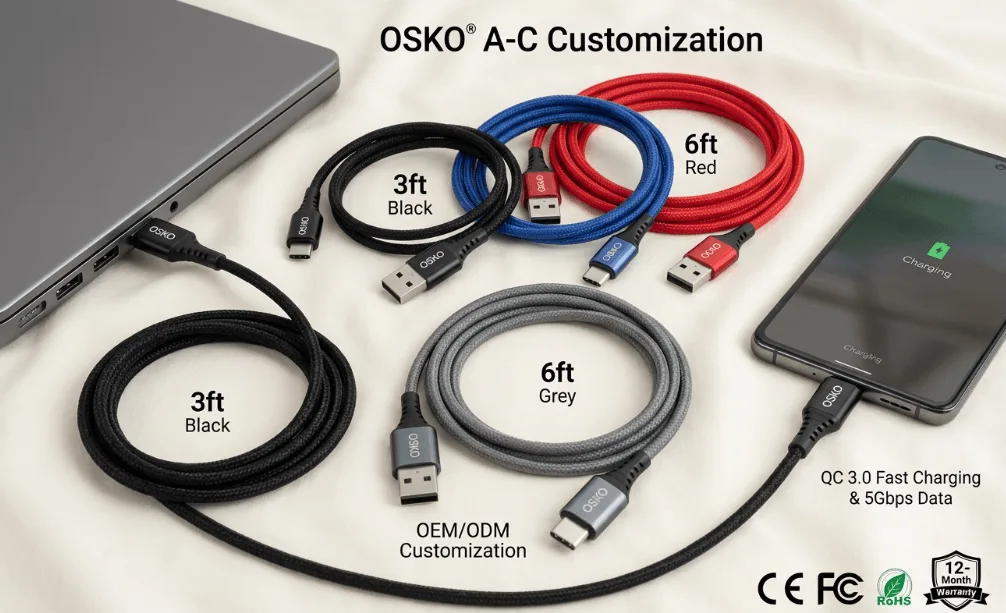
Custom logo printing on connectors
Private label packaging design (Amazon + retail-ready)
Multi-language instruction inserts for US/EU markets
SKU structure design (1m / 2m / 3ft / 6ft variations)
Result:
Product shifted from commodity cable to branded accessory line.
5. SKU Expansion Strategy for Market Scaling
We designed a structured SKU system for pricing and market segmentation:
Entry-level: 60W USB-C cable (budget segment)
Mid-tier: 100W USB-C cable (laptop users)
Premium tier: 240W PD 3.1 cable (high-performance devices)
Bundle sets: 2-pack / 3-pack Amazon listings
Result:
Enabled multi-tier pricing strategy and improved average order value.
Final Results
After implementing the custom USB-C cable manufacturing solution:
Product return rate reduced by 58%
Average selling price increased by 35%
Conversion rate improved by 42%
Repeat purchase rate increased significantly due to SKU expansion
Brand successfully entered premium USB-C cable segment
The client transitioned from a commodity seller to a structured OEM brand owner.
Key Takeaways
USB-C cable success depends on engineering + branding + SKU strategy, not just manufacturing
PD performance stability is critical for reducing returns and improving reviews
OEM customization is essential for escaping price competition
Structured SKU design increases long-term revenue scalability
Why This Case Matters
This case demonstrates that USB-C cables are no longer simple accessories—they are engineered product systems that require:
Electrical design precision (PD 3.0 / 3.1)
Material science optimization (braided vs silicone vs TPE)
E-commerce alignment (Amazon / Shopify conversion strategy)
Brand differentiation through OEM manufacturing
Contact Us
To build your own custom USB-C cable product line, please provide:
Target market (Amazon / wholesale / retail)
Required wattage (60W / 100W / 240W)
Material preference (braided / silicone / TPE)
Branding requirements (logo, packaging, SKU structure)
Estimated order volume
We will deliver a custom OEM manufacturing proposal within 24 hours.
